Saint Petersburg does not have a waterfront. It has about forty kilometres of them, and they are the architecture — not the frame around it. The city was laid out facing water, its best façades turned toward the river, and its granite embankments were built as public rooms rather than flood defences. This is a guide to the ones actually worth walking, what stands on each, and how to plan a route that does not end with you stranded on the wrong bank at two in the morning.
Why the granite matters
For the first sixty years the banks of the Neva were wood and earth, and they collapsed regularly. Facing them in granite began in the 1760s under Catherine II, largely to designs by Yury Felten, and the work continued for decades. The stone came by water from Finland and Karelia.

The result is something most visitors feel without identifying: the same grey-pink granite, the same parapet height, the same rhythm of stairs down to the water, holding together buildings from three different centuries. When people say the centre of Petersburg looks "whole", this is largely what they are reacting to.
One practical consequence: the descents to the water are genuinely slippery in rain and ice, they have no railings, and the river is cold in every month of the year. They are for sitting on, not for scrambling down at night.
Palace Embankment — the one on the postcards
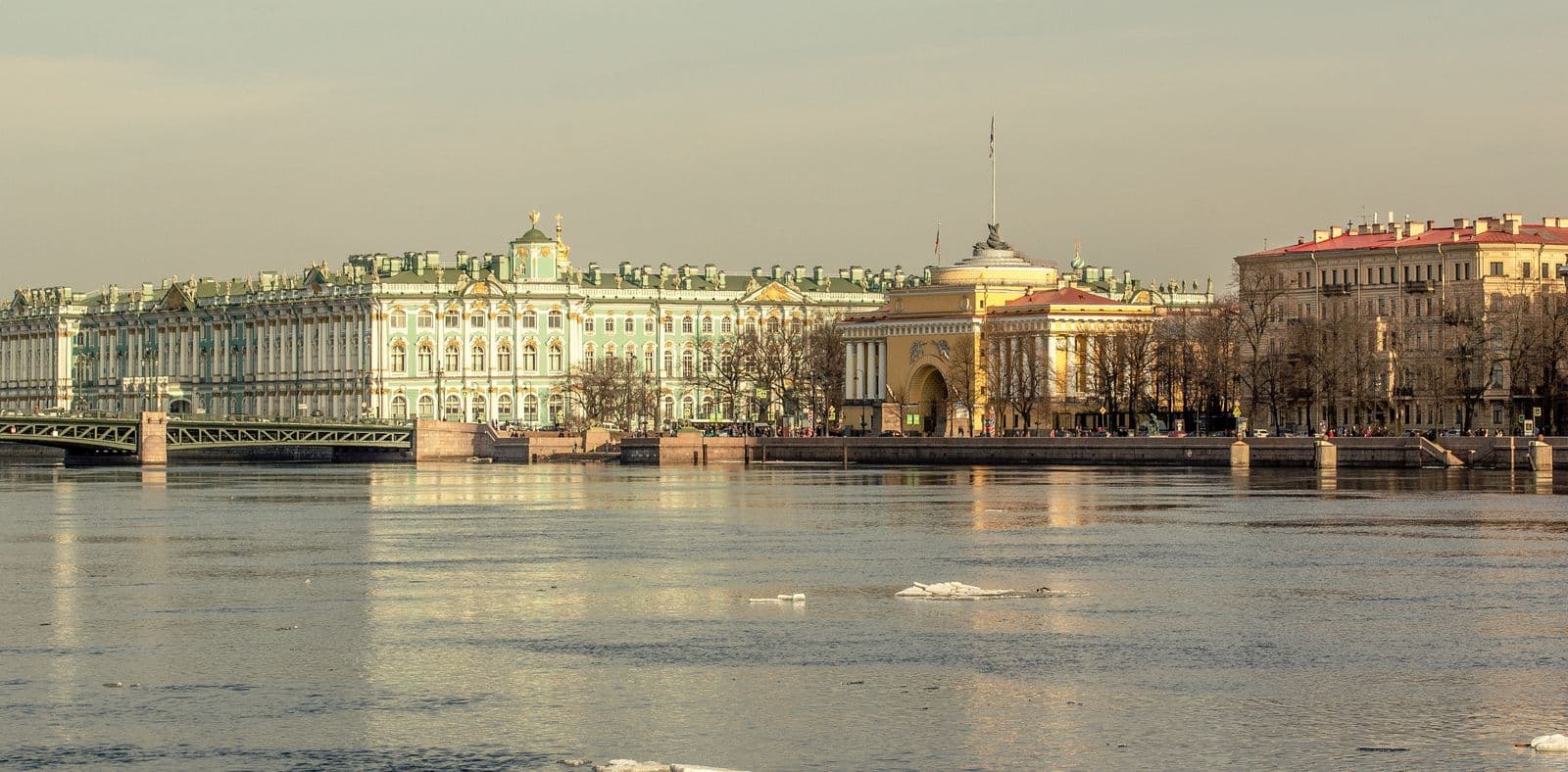
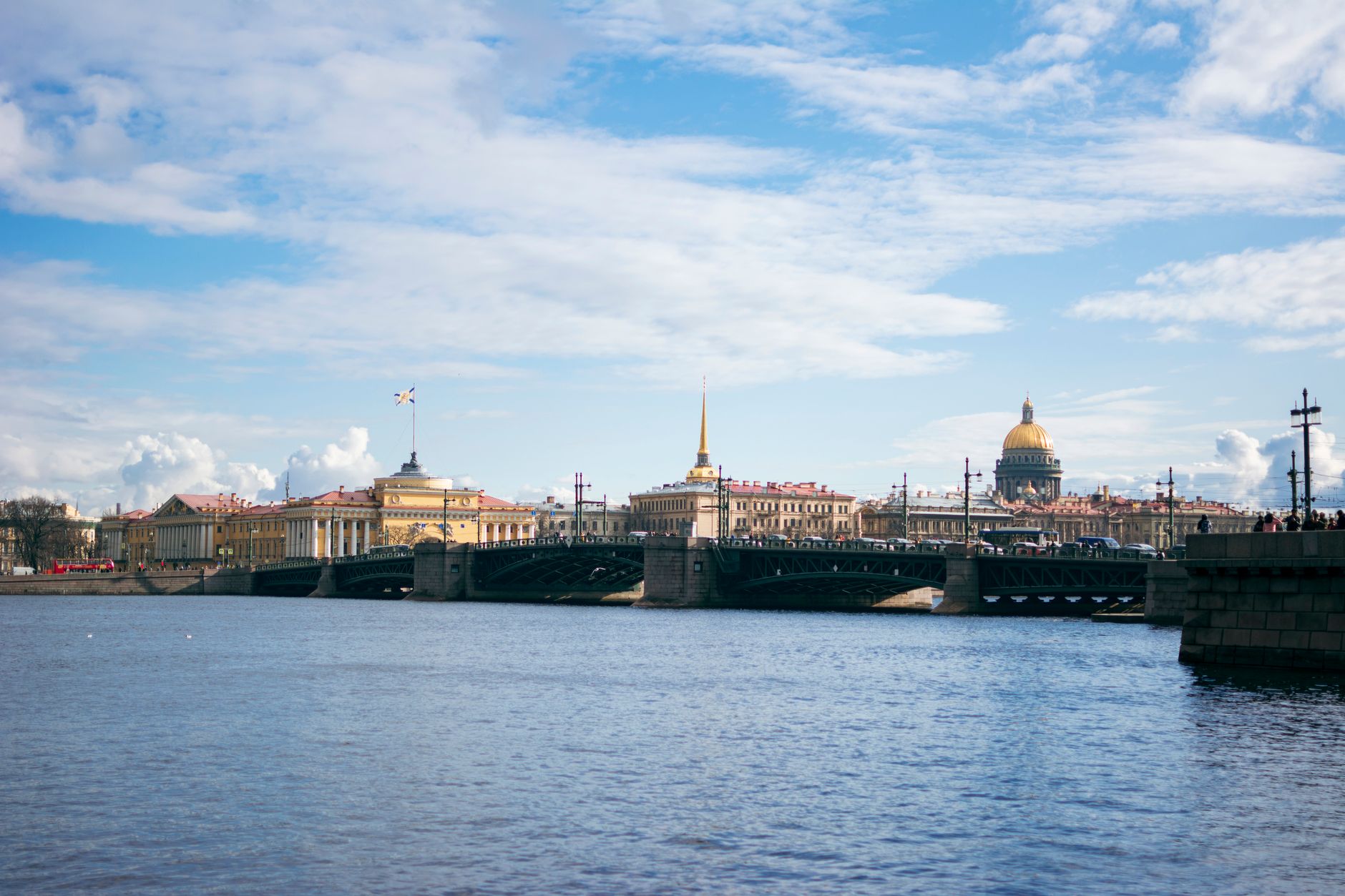
The stretch from the Summer Garden to the Admiralty is the most photographed in the city and, unusually, deserves it. Along it stand the Winter Palace and the rest of the Hermitage complex, the Marble Palace built by Antonio Rinaldi for Grigory Orlov, the New Hermitage with its atlantes, and the Summer Garden behind its Neva railing.
The view is across the water rather than at the buildings: from here you see the Peter and Paul Fortress spire, the Rostral Columns and the Spit of Vasilievsky Island in one sweep. Late afternoon light comes from behind you and lands on the far bank, which is the right way round for photographs.
It is also the busiest embankment in the city. If you want it without crowds, come before nine in the morning; tour groups arrive with the museums.
University Embankment — sphinxes three thousand years older than the city
On the Vasilievsky Island side, opposite the Admiralty, stand two granite sphinxes carved for the pharaoh Amenhotep III at Thebes. They are roughly fourteenth-century BC, were bought for Russia in the 1830s, and have sat on this embankment since 1834. They are, by a wide margin, the oldest objects on display anywhere in the city.
Behind them runs a line of buildings that is essentially the history of Russian science and art in one row: the Kunstkamera with its tower, the Twelve Colleges, the Academy of Sciences, and further along the Academy of Arts with its own pier.
This bank is also the better vantage point for the Bronze Horseman and St Isaac's dome, because you are looking at them across open water with nothing in the way.
English Embankment — the same river without the crowd
Immediately west of the Admiralty, the English Embankment has far fewer people on it than the Palace Embankment, while the view is almost the same. It took its name from the English merchants who settled along it in the eighteenth century, spent most of the Soviet period as Red Fleet Embankment, and got its old name back in 1994.
The buildings are mansions rather than palaces, which means the frontage is lower, quieter and more consistent. If you have one hour and want to understand what a Petersburg embankment is, walk this one rather than the famous one.
Admiralty Embankment and the Bronze Horseman
Short, central, and built much later than its neighbours — it was laid out in the 1870s, when the Admiralty shipyards were cleared from the riverfront. At its western end is Senate Square and Falconet's monument to Peter the Great, unveiled in 1782 and standing on a single glacial boulder that was hauled overland and by barge from the Gulf coast.
The granite pier here, with its lions and porphyry vases, is one of the few places in the centre where you can sit at water level directly under the main sights.
Petrovskaya Embankment — where the city actually started
On the Petrogradsky side, this is the short stretch containing the Cabin of Peter the Great: a log house of 1703, the oldest surviving building in Saint Petersburg, now enclosed in a protective brick shell.
In front of it sit two Shih Tsza — Manchurian guardian lions brought from Girin and installed in 1907. They look nothing like anything else in the city, which is the point.
Lieutenant Schmidt Embankment — the working river
Downstream on Vasilievsky Island, the river stops being scenery and starts being a port. Moored here is the icebreaker Krasin, built in 1916 and now a museum ship you can go aboard.
This is the embankment to walk if you want the Neva as a working waterway: cranes, moored vessels, wind off the Gulf, and considerably fewer people.
The canals: Moika, Griboedov, Fontanka
The Neva embankments are the grand ones. The canal embankments are the ones people remember, because the scale drops to something human — you are two or three metres above the water instead of five, and the far bank is close enough to see into the windows.

- The Moika runs past the Yusupov Palace, where Rasputin was murdered in 1916, and past Moika 12, the flat where Pushkin died after his duel. Near its mouth is New Holland, an eighteenth-century complex of warehouses built to season ship timber — never a shipyard — on its own triangular island, reopened as a public park in 2016.
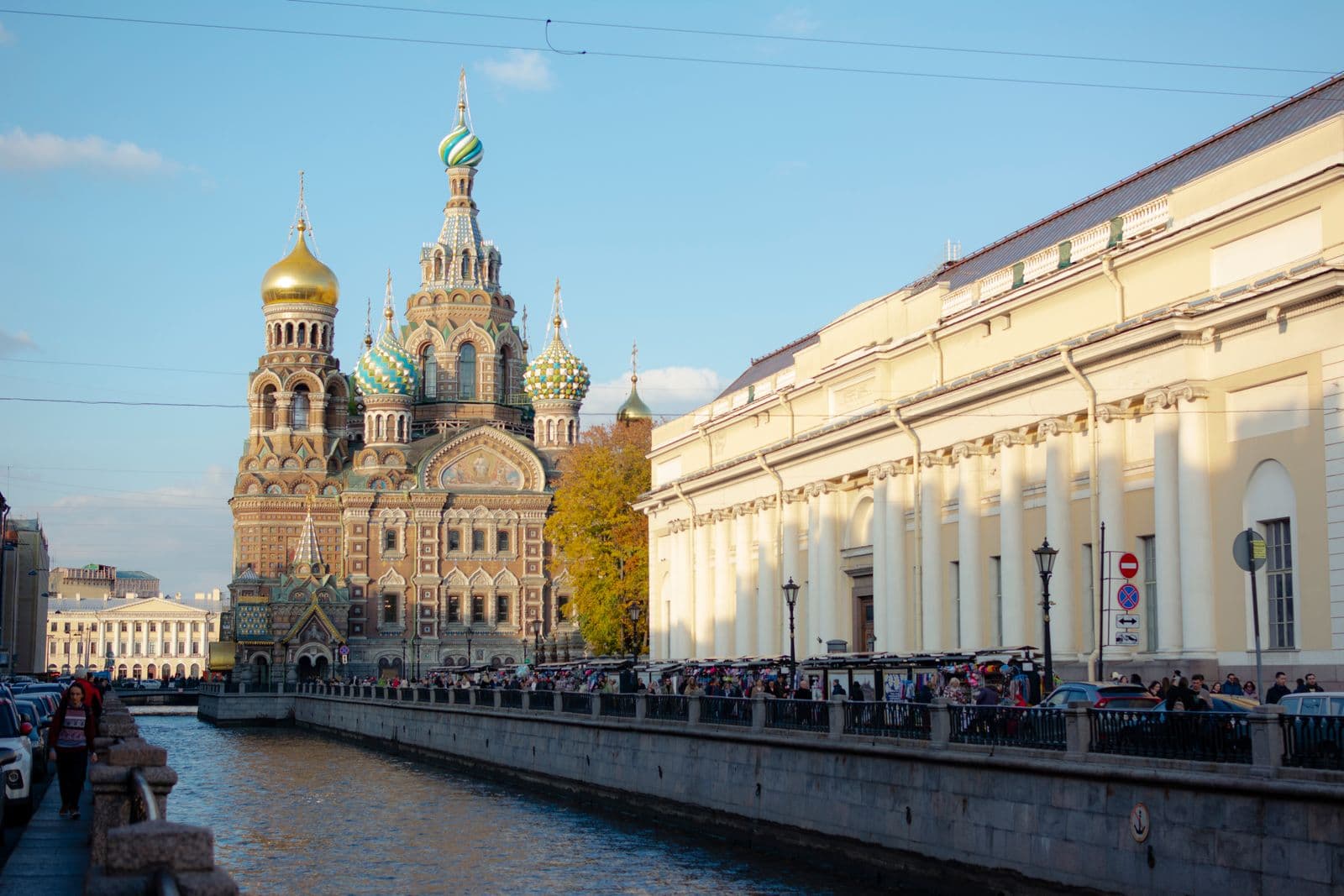
- The Griboedov Canal gives you the Church of the Savior on Spilled Blood head-on, which is the view every photograph of it uses. Two small bridges here are worth the detour: Bank Bridge with its four gilded-winged griffins, and Lion Bridge, both from 1826 and both by the sculptor Pavel Sokolov.
- The Fontanka is the widest and the busiest with boat traffic. At Nevsky Prospekt it passes under the Anichkov Bridge and Pyotr Klodt's four horse-tamer groups, installed between the 1840s and 1850s; a little further along stands the Sheremetev Palace, the Fountain House, with the Akhmatova museum in its garden wing.
Voskresenskaya Embankment — the quietest and the heaviest
Well upstream of the tourist centre, this embankment holds Mikhail Shemyakin's memorial to the victims of political repression: two bronze sphinxes facing the water, serene in profile from the river side, skulls from the city side. They stand deliberately opposite the Kresty prison on the far bank.
It is a twenty-minute walk from anything else on this list and almost always empty. Go if you want the city to stop being pretty for a few minutes.
Practical notes
Check the bridge schedule before a late walk. From roughly mid-April to mid-November the Neva bridges open at night for shipping, and once they are up the banks are separated for hours. Crossing back by taxi is not an option — there is no crossing. Watching a bridge open is worth doing on purpose; being on the wrong side of one by accident is not.
Wind, not temperature, decides how the walk feels. The embankments are fully exposed and the wind comes straight off the Gulf of Finland. A calm day in March is more comfortable on the river than a windy day in June.
White nights change the schedule, not the light. From late May to mid-July the sky never fully darkens, and the embankments stay busy past midnight. The light is flat rather than golden — good for the river, less good for the buildings.
A route that works in half a day: start at the Summer Garden, walk the Palace Embankment to the Admiralty, cross Palace Bridge to Vasilievsky Island, walk back along University Embankment past the sphinxes, then cross Blagoveshchensky Bridge to the English Embankment. That gives you both banks, both directions of light, and ends near the metro rather than in the middle of an island.