The Russian Museum of Ethnography and the Kunstkamera are often confused or treated as interchangeable: both are about peoples and costumes, both are central, both are inexpensive. In reality they are two very different museums. The Museum of Ethnography covers the peoples of Russia and neighbouring countries in a huge ceremonial building next to the Russian Museum. The Kunstkamera is the country's oldest museum, founded by Peter the Great, with collections from all over the world and the famous anatomical collection of Frederik Ruysch.
Below is a comparison of what really matters: what each museum is about, who each suits, how much time to allow and whether you can do both in a day. We checked prices, opening hours and closing days on the official websites ethnomuseum.ru and kunstkamera.ru on 19 October 2026 — note that the Kunstkamera has a special schedule with no closing days from 21 October to 8 November.
🏛 The Museum of Ethnography: the Marble Hall and the peoples of Russia
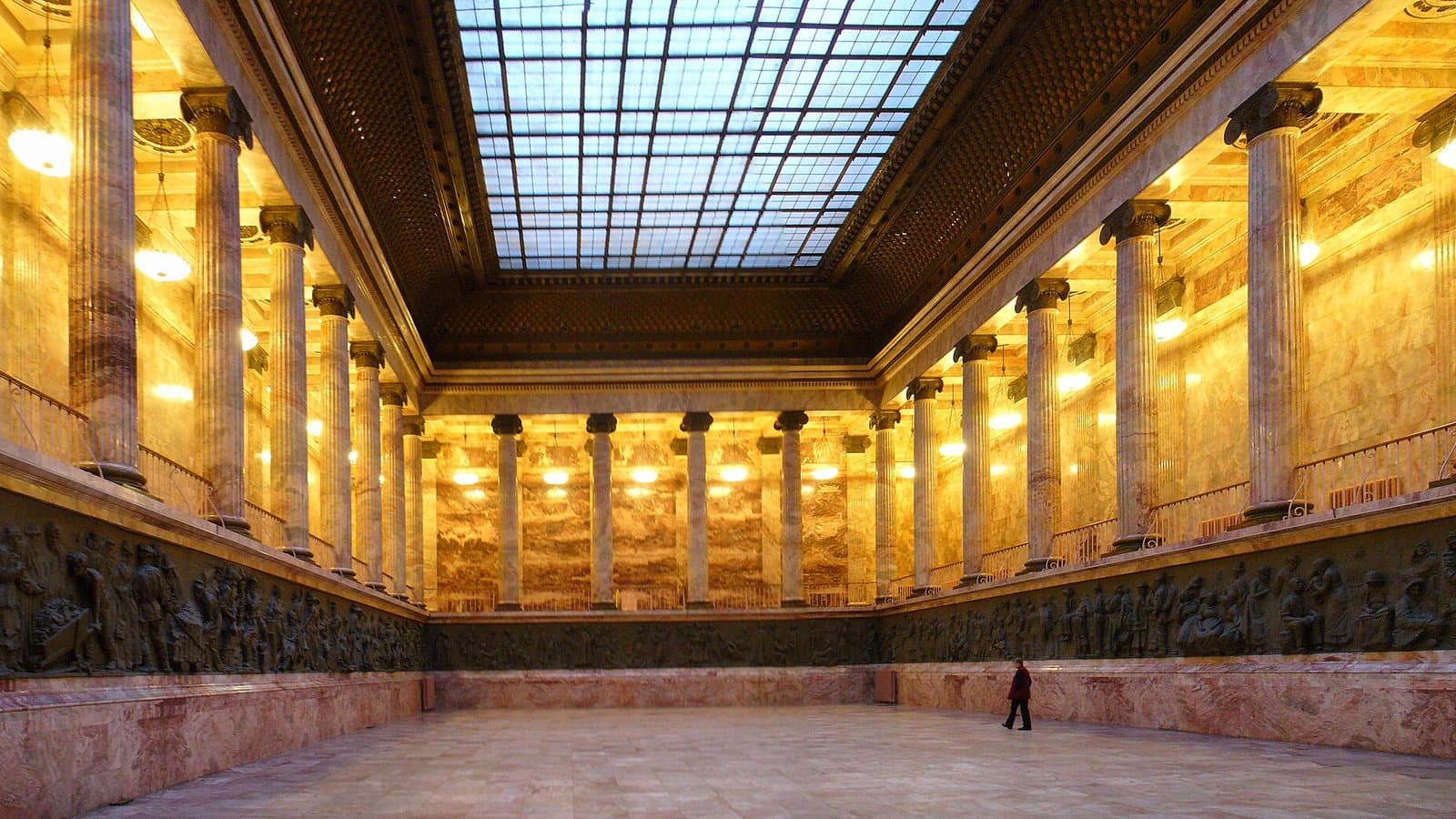
The Russian Museum of Ethnography's biggest impression is the building itself. It was designed in the early 20th century by the architect Vasily Svinyin for the Ethnographic Department of the Russian Museum, and the museum calls it one of the outstanding works of St Petersburg architecture of its time. At its heart is the Marble Hall: a colonnade of pink marble quarried at Tivdiya in Karelia, a glass ceiling and a sculpted frieze running round the whole room.
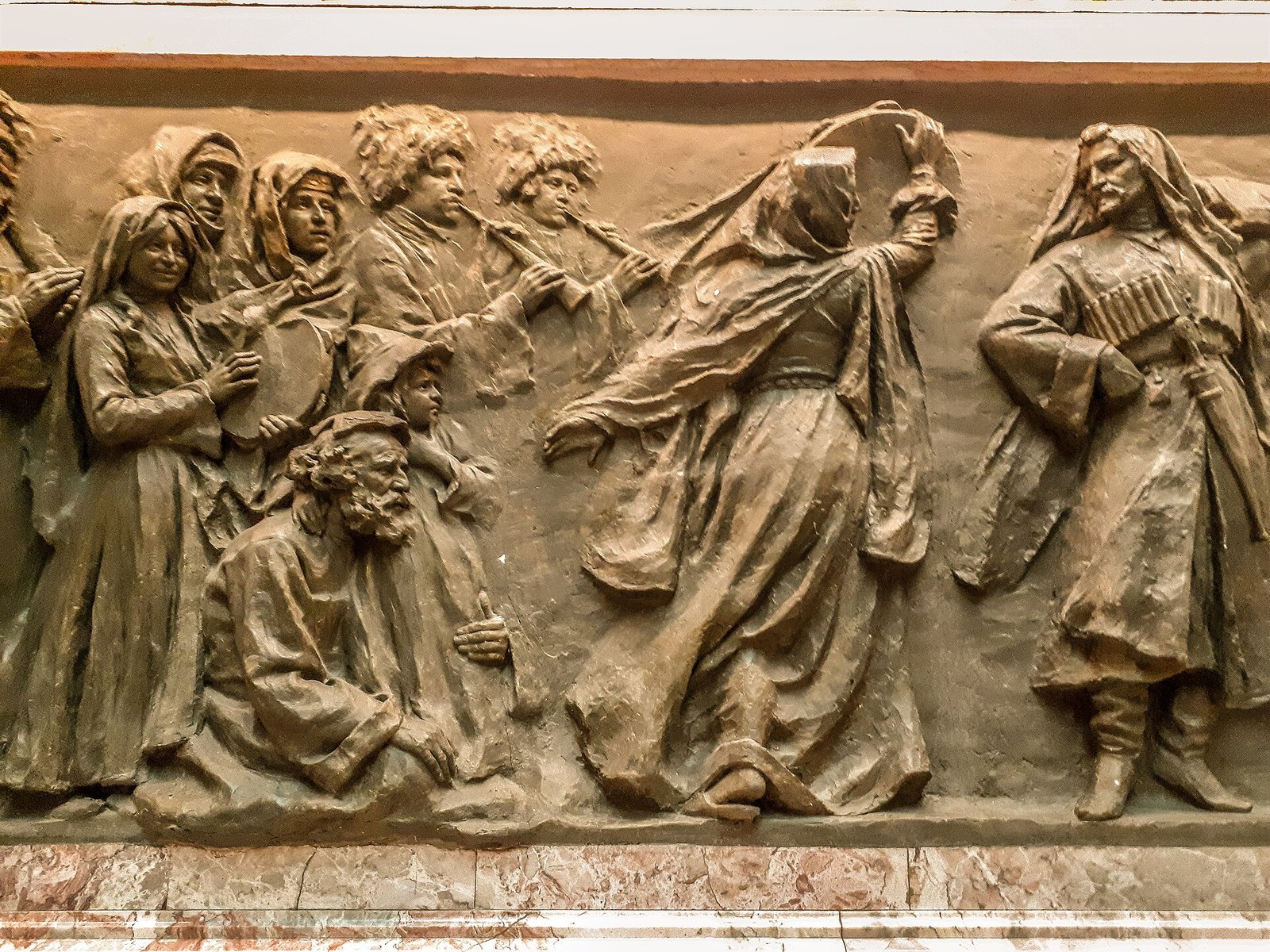
Part of the sculpted frieze in the Marble Hall: dancers in traditional costume — Photo: Aleksandrovy AG, Wikimedia Commons, CC BY-SA 4.0
Be aware that the Marble Hall may be closed to visitors on event days; the museum suggests checking by phone on +7 (812) 570-54-21.
The permanent displays cover the peoples of Russia and the former empire around 1900: Russians, Belarusians, Ukrainians, Moldovans, the peoples of the Volga and Urals, of north-west Russia and the Baltic, of Central Asia and Kazakhstan, of the South Caucasus, and "The Arctic — an Inhabited Land". There are also "Treasures of the Special Storeroom", with gifts to the tsars from the emirs of Bukhara and Buddhist delegations, and "Bone, Horn, Amber". Expect a lot of village life: stoves, household objects, costumes, weddings and festivals.
🗼 The Kunstkamera: Peter's tower and a museum of the world
The Kunstkamera — officially the Peter the Great Museum of Anthropology and Ethnography of the Russian Academy of Sciences — stands at 3 Universitetskaya Embankment, across the Neva from the Winter Palace. Peter the Great founded it in 1714, and the building's distinctive tower is the symbol of Russia's first museum.
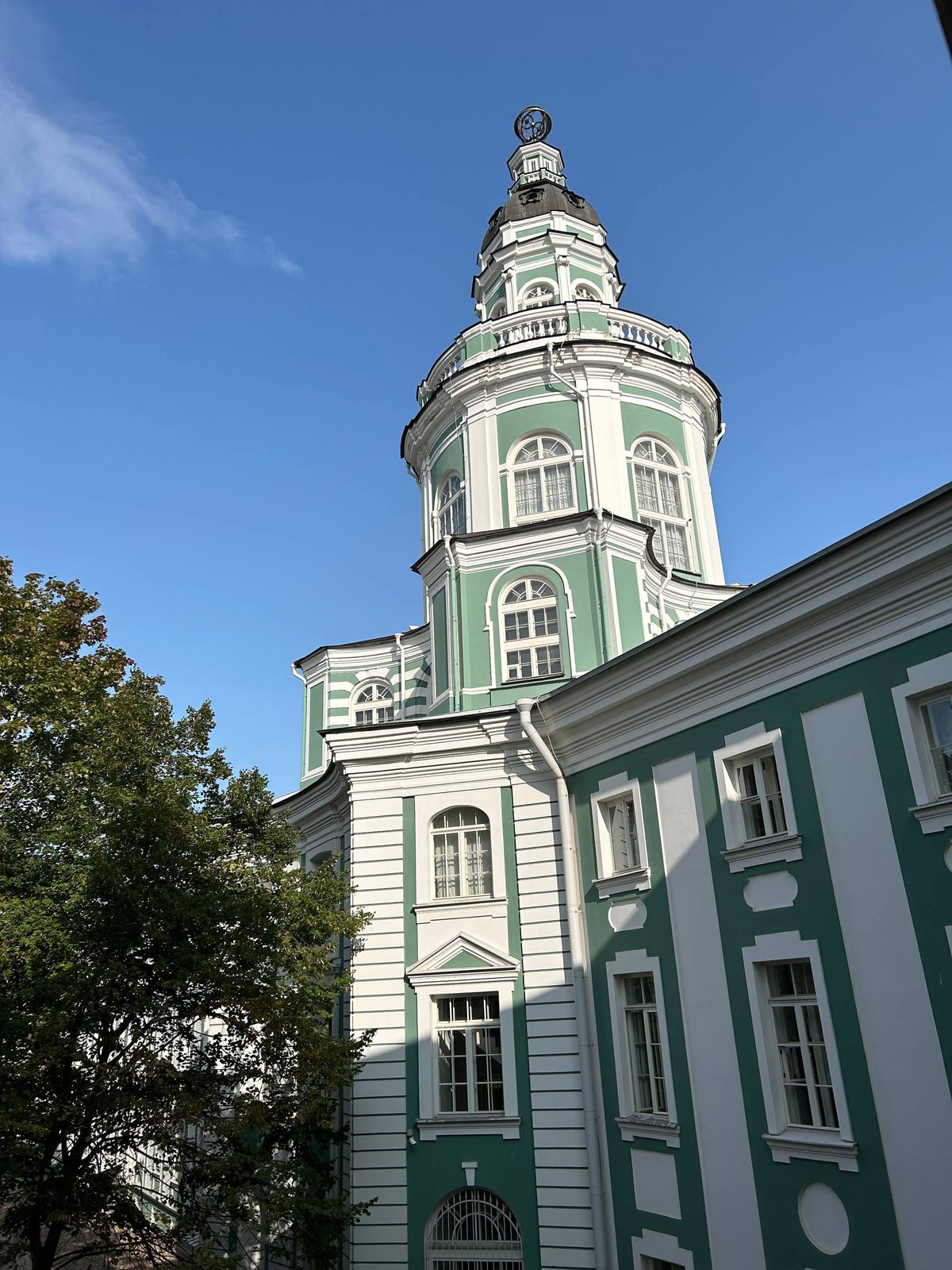
The Kunstkamera tower against a blue sky — Photo: PiterPass
Here the focus is not Russia but the world: rooms on North and Latin America, Africa, Indochina, South Asia, Japan, China, Korea, Mongolia and the Middle East. The tower holds "Peter's Kunstkamera", opened in 2022: the natural specimens, rarities and curiosities of Peter's time, including the famous anatomical collection of the Dutch anatomist Frederik Ruysch. There's a Russia room too — "The Imperial Hall: Multinational Russia", with the porcelain series "Peoples of Russia" and gifts presented to the emperors.
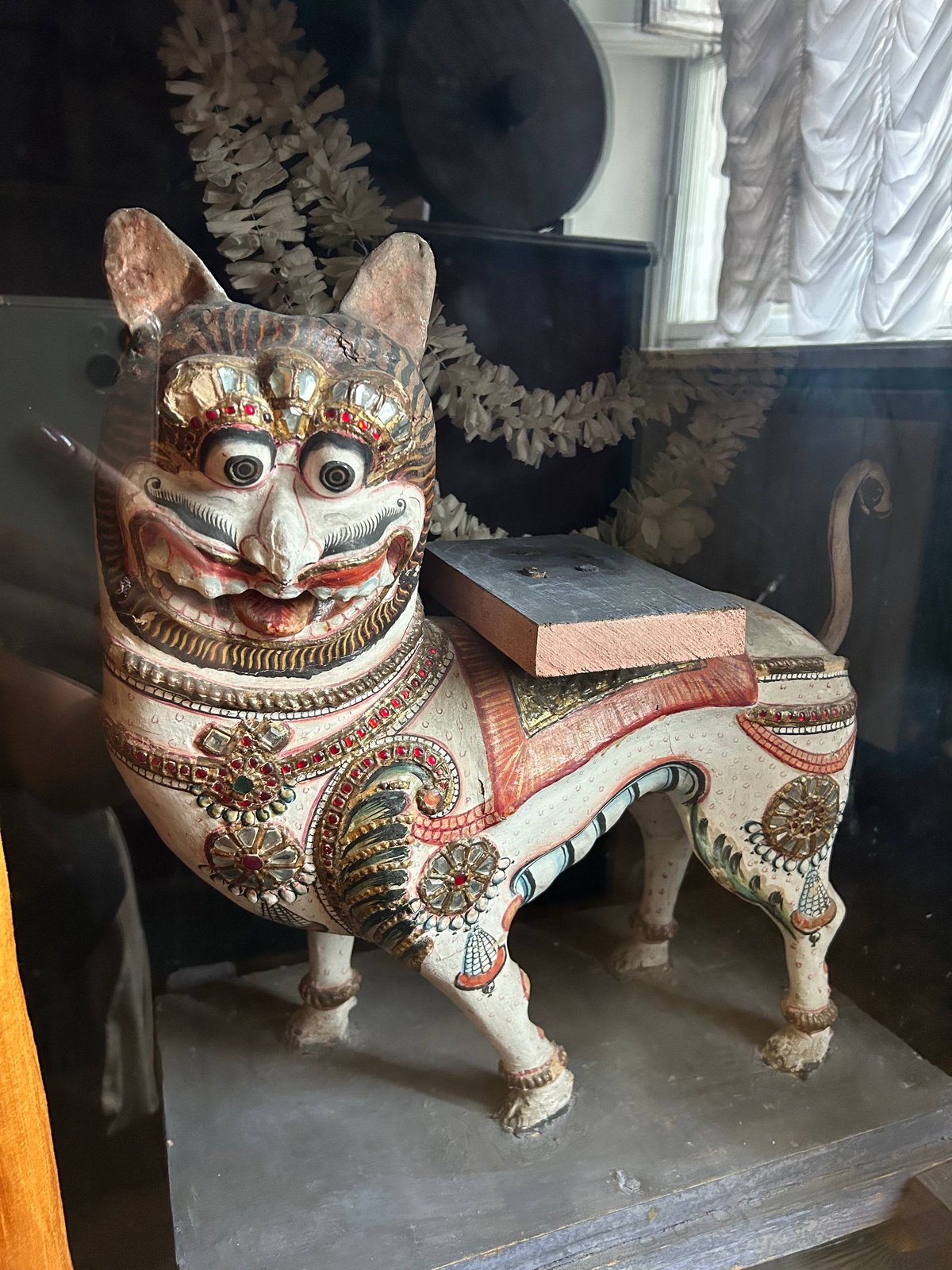
A painted wooden animal figure in a Kunstkamera display case — Photo: PiterPass
The Great Gottorp Globe and the first astronomical observatory in the tower can only be visited with a guide — by advance booking or as part of a scheduled group tour. The display in the tower basement, "The Kunstkamera in the War Years", is also guide-only.
⚖️ How they differ and who each suits
- Subject. The Museum of Ethnography: the peoples of Russia and the former empire, village life and festivals. The Kunstkamera: peoples of every continent, plus the history of science and the anatomical collection.
- Atmosphere. Ethnography: space, grand halls and the Marble Hall. Kunstkamera: densely packed display cases in an 18th-century building.
- Anatomy. If you'd rather not see anatomical specimens, start with the Museum of Ethnography; in the Kunstkamera that section is in "Peter's Kunstkamera" in the tower.
- With children. We cover the age question in detail in Kunstkamera: what age is it suitable for.
- Time. We'd allow 2–3 hours for the Museum of Ethnography and an hour and a half to two hours for the Kunstkamera.
🎟 Prices, hours and closing days
Russian Museum of Ethnography, 4/1 Inzhenernaya Street (walking distance from Nevsky Prospekt and Gostiny Dvor metro):
- Open Wednesday to Sunday 10:00–18:00 (ticket office until 17:00), Tuesday until 21:00 (ticket office until 20:00). Closed on Mondays.
- Timed entry: sessions every half hour from 10:00 to 17:00.
- Ticket: 600 roubles. Students from Russia and the EAEU: 300; pensioners from Russia and the EAEU: 250; children aged 7–16: 200; family ticket for up to four people with children under 16: 1,200.
- The museum warns that online tickets are sold only on its official website.
Kunstkamera, 3 Universitetskaya Embankment:
- Normally open Tuesday to Sunday 10:00–18:00, last entry 17:00. Closed on Mondays and the last Tuesday of the month. 20 October 2026 is a cleaning day, and from 21 October to 8 November the museum is open every day.
- Ticket: 500 roubles; school pupils, students, cadets and pensioners: 300.
- Tickets are sold for timed sessions on the official website and at the museum's ticket office; bank cards are accepted, though cards issued outside Russia generally don't work in the country.
- Private tour in Russian for up to 5 adults: 4,500 roubles; in a foreign language for up to 4 people: 6,500.
- The third Thursday of the month from September to April is a free day for individual visitors.
Both museums use timed entry, so at weekends and in school holidays it's easier to buy a ticket online for a specific session than to queue at the desk.
🚶 Can you do both in one day?
Yes, as long as you don't try to see everything. Tuesday works best: the Kunstkamera is open until 18:00 and the Museum of Ethnography stays open until 21:00 on Tuesdays. From 21 October to 8 November the Kunstkamera has no closing day, but the Museum of Ethnography is always closed on Mondays, so Monday won't work for the pair.
- 10:00 — the Kunstkamera, first session. An hour and a half to two hours.
- Around 12:00 — walk across Palace Bridge and Palace Square to Inzhenernaya Street. We'd estimate 30–40 minutes at an easy pace; it's cold on the bridge when the wind is up.
- Lunch in the centre — see our guide to eating cheaply in St Petersburg.
- From 14:00 — the Museum of Ethnography, 2–3 hours. On Tuesdays there's no rush: the ticket office is open until 20:00.
The Russian Museum is right next door; if you'd like to stay in the area, see our guide Russian Museum: tickets and route. Remember it gets dark around 16:30 in November, so do the embankment walk in daylight.
🧭 Good to know
- The Museum of Ethnography is always closed on Mondays; the Kunstkamera is too, except between 21 October and 8 November 2026.
- The Gottorp Globe and the Kunstkamera's basement display are guide-only; a standard ticket won't get you in.
- The Marble Hall can close for events — call ahead if it's the reason you're going.
- The Kunstkamera states that it has no ramps, lifts or platform lifts.
- Not for you: the Kunstkamera if anatomy upsets you; the Museum of Ethnography if you want "wow" objects from around the world rather than village life.
📌 In short
✅ The Museum of Ethnography: the peoples of Russia and the former empire, a ceremonial building and the Marble Hall. The Kunstkamera: peoples of the world, Peter the Great's collections and Ruysch's anatomy.
✅ Museum of Ethnography: 4/1 Inzhenernaya Street; Wed–Sun 10:00–18:00, Tue until 21:00, closed Mondays; ticket 600 roubles.
✅ Kunstkamera: 3 Universitetskaya Embankment; normally Tue–Sun 10:00–18:00, open daily from 21 October to 8 November; ticket 500 roubles.
✅ Both use timed sessions — buy tickets online on the official websites.
✅ Both in a day is doable: the Kunstkamera in the morning, a walk over Palace Bridge, the Museum of Ethnography after lunch — ideally on a Tuesday.
If you're choosing just one: for Russia and the most beautiful hall, go to the Museum of Ethnography; for the whole world and Peter the Great's story, the Kunstkamera. Checked on 19 October 2026 against the official websites of the Russian Museum of Ethnography and the Peter the Great Museum of Anthropology and Ethnography (Kunstkamera) of the Russian Academy of Sciences.
❓ Questions and answers
How is the Ethnographic Museum different from the Kunstkamera?
The Russian Museum of Ethnography is about the peoples of Russia and the former empire at the turn of the 20th century and is famous for its Marble Hall. The Kunstkamera covers peoples of every continent, Peter the Great's collections and the history of science, including Ruysch's anatomical collection.
How much are tickets to the Ethnographic Museum and the Kunstkamera?
As of 19 October 2026 an adult ticket to the Russian Museum of Ethnography costs 600 roubles and to the Kunstkamera 500 roubles. Concessions are 200–300 roubles. Both museums admit visitors by timed sessions.
Can I visit both museums in one day?
Yes. Tuesday works best: the Kunstkamera in the morning (until 18:00), then a walk across Palace Bridge to the Ethnographic Museum, which is open until 21:00 on Tuesdays. The Ethnographic Museum is closed on Mondays.
Cover photo: Artyom Svetlov, Wikimedia Commons, CC BY 4.0