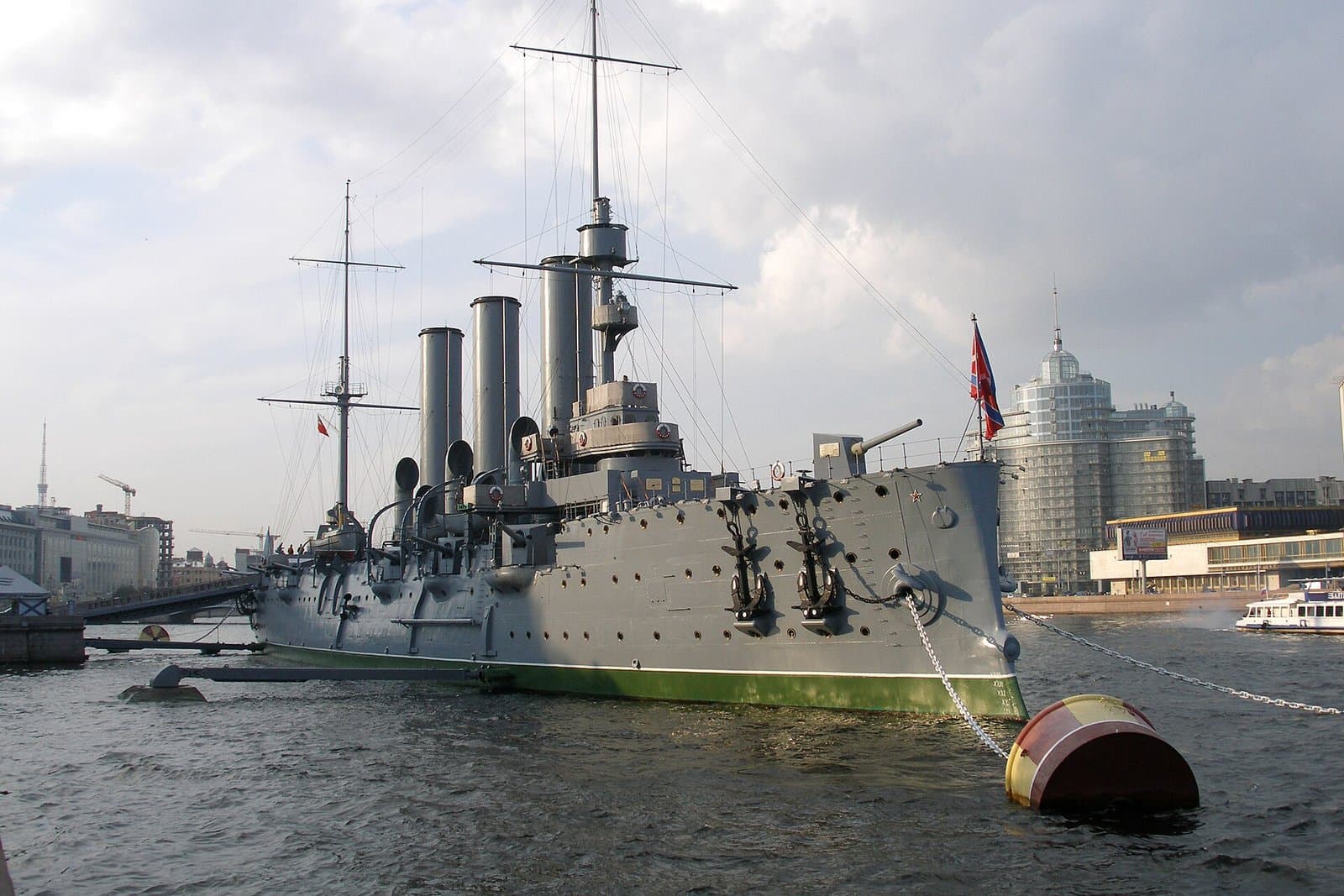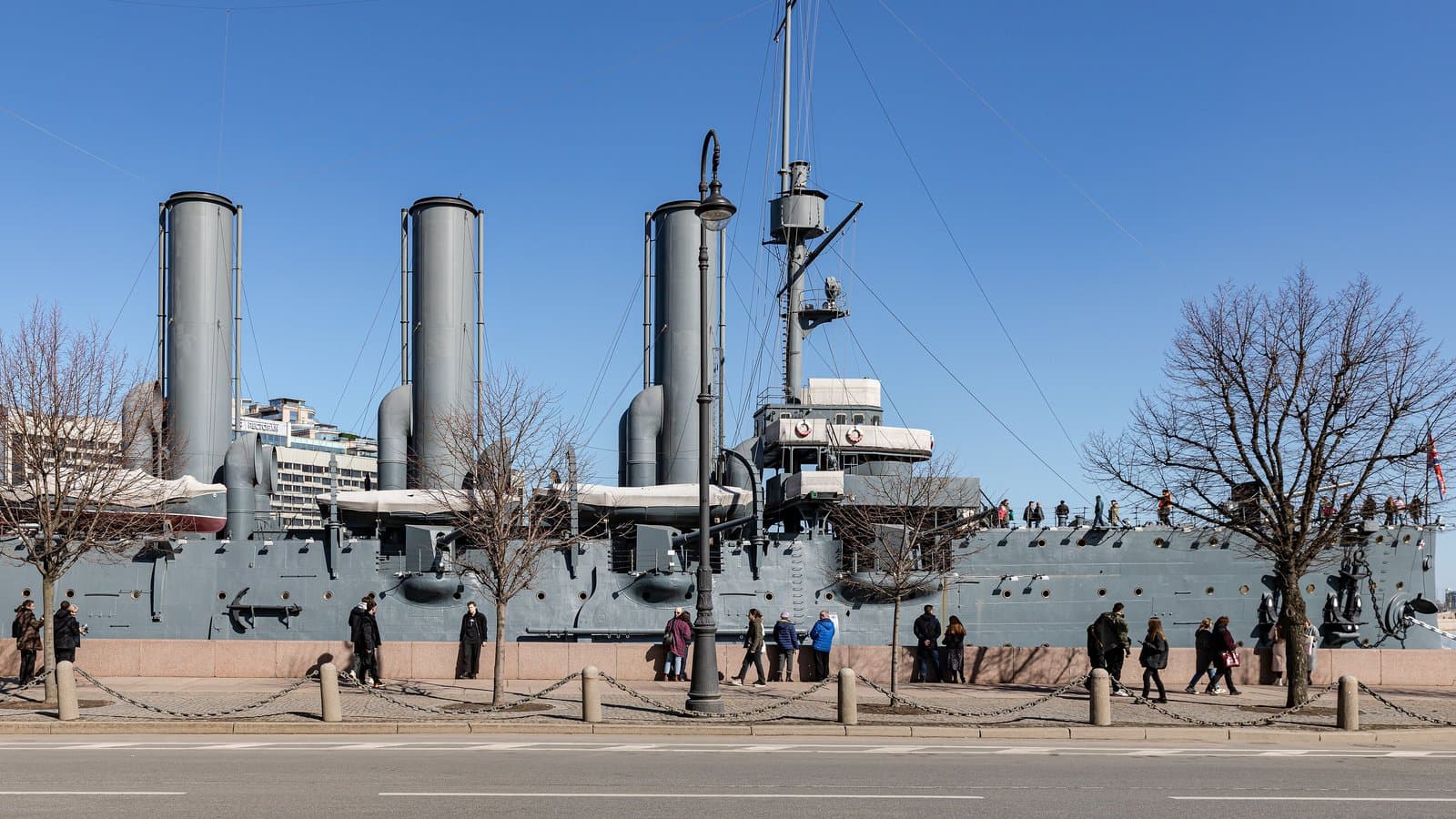
St Petersburg has two big museum ships, both moored along central embankments: the cruiser Aurora (Avrora) on Petrogradskaya Embankment and the icebreaker Krasin on Lieutenant Schmidt Embankment (naberezhnaya Leytenanta Shmidta) by the Mining Institute. They are very different museums: Aurora is a warship with exhibitions on the navy and the 1917 revolution, while on Krasin, a polar icebreaker, you walk through the cabins, the wardroom and the captain's bridge. Both are open in autumn, and both make a good plan for a windy, rainy day.
On 19 October 2026 we checked the websites of the Central Naval Museum and the Icebreaker Krasin museum, plus Yandex Maps, for where the ships are, what you can see inside, ticket and tour prices, opening days, restrictions and whether you can see both in one day. Note that Krasin's entry prices change on 21 October — the new ones are given below. Payment is by Russian bank card or cash: cards issued abroad generally do not work in Russia.
⚓ Aurora: a cruiser, the navy and the revolution
Aurora is a branch of the Central Naval Museum at 2 Petrogradskaya Embankment. The cruiser was laid down in 1897, fought at the Battle of Tsushima in 1905, and on 25–26 October 1917 her sailors took part in the armed uprising in Petrograd. She was placed on permanent mooring at Petrogradskaya Embankment in 1948, and the shipboard museum opened in 1956.
On your own you can see the upper deck and six exhibition halls: the cruiser's history, sailors' service and daily life at the turn of the 20th century, the First World War and the revolution, the Second World War, and the ship as a museum. The naval medicine rooms — the ship's doctor's office and sick bay — and the historic engine and boiler rooms are shown only on guided tours.
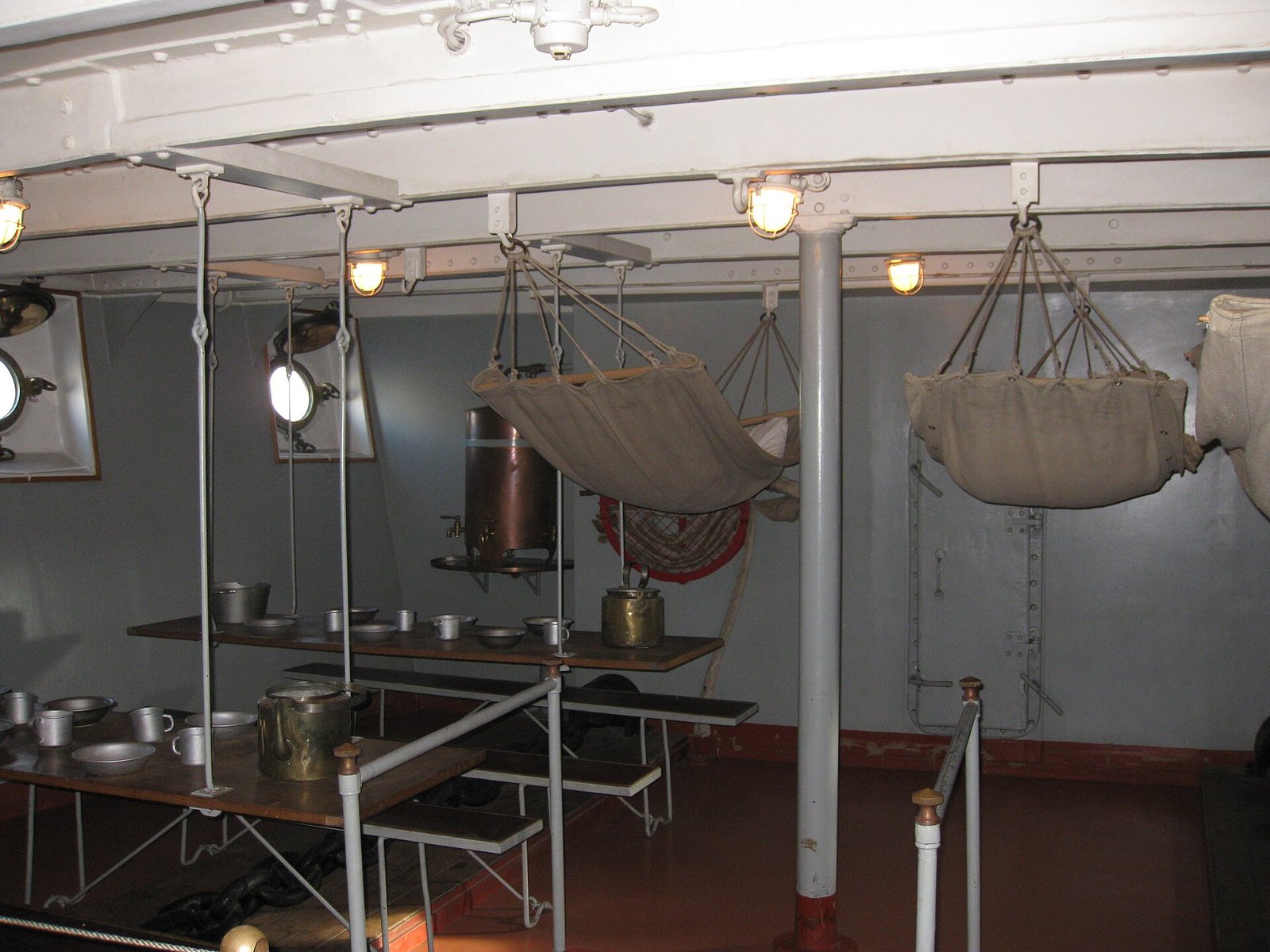
The sailors' mess deck on Aurora: hanging hammocks and tables laid with tableware — Photo: Deror avi, Wikimedia Commons, CC BY-SA 3.0
One important point: the cruiser is a military unit's territory, so the rules are stricter than in a normal museum. Backpacks of any size, bags larger than 20×30 cm, food and drink go into the left-luggage room; pushchairs and scooters are not allowed on board, and there is no visitor toilet on the ship.
🎟 Aurora: hours, tickets, tours
The cruiser is closed on Mondays and Tuesdays. From 1 September to 30 April it is open Wednesday to Sunday, 11:00–18:00, with the ticket office and entry closing at 17:15. The nearest metro stations are Gorkovskaya and Ploshchad Lenina (about 1.5 km away according to Yandex Maps); trams 6 and 40 and bus 28 run from them.
Entry costs 600 roubles for citizens of the Eurasian Economic Union (Russia, Belarus, Kazakhstan, Armenia, Kyrgyzstan) and 1,000 roubles for all other foreign visitors. Tickets are sold at the branch ticket office and on the museum's website; tickets bought online must be printed. Tours: the overview covers the upper deck and six halls in 45 minutes — 1,000 roubles per person in a group of six or more, or 2,500 roubles per group of up to five plus entry tickets; the extended tour adds the engine and boiler rooms and the medical rooms, 90 minutes, 1,400 roubles, children only from age 10; the themed lecture-tour of the engine room and medicine takes 45 minutes and costs 1,100 roubles. For non-EAEU visitors there is a foreign-language overview tour: 1,800 roubles per person in a group of more than five, or 4,000 roubles per group of up to five plus entry tickets.
❄️ Krasin: a polar icebreaker with cabins and a bridge
Krasin is a branch of the Museum of the World Ocean, on Lieutenant Schmidt Embankment by 23rd Line (23-ya liniya) of Vasilyevsky Island. The icebreaker was built in Britain in 1916–1917 as Svyatogor and renamed in 1927 after the Soviet commissar Leonid Krasin. Her defining moment came in 1928: of all the rescue ships, only Krasin broke through the heavy ice to reach survivors of Umberto Nobile's expedition, whose airship Italia had crashed in the Arctic.
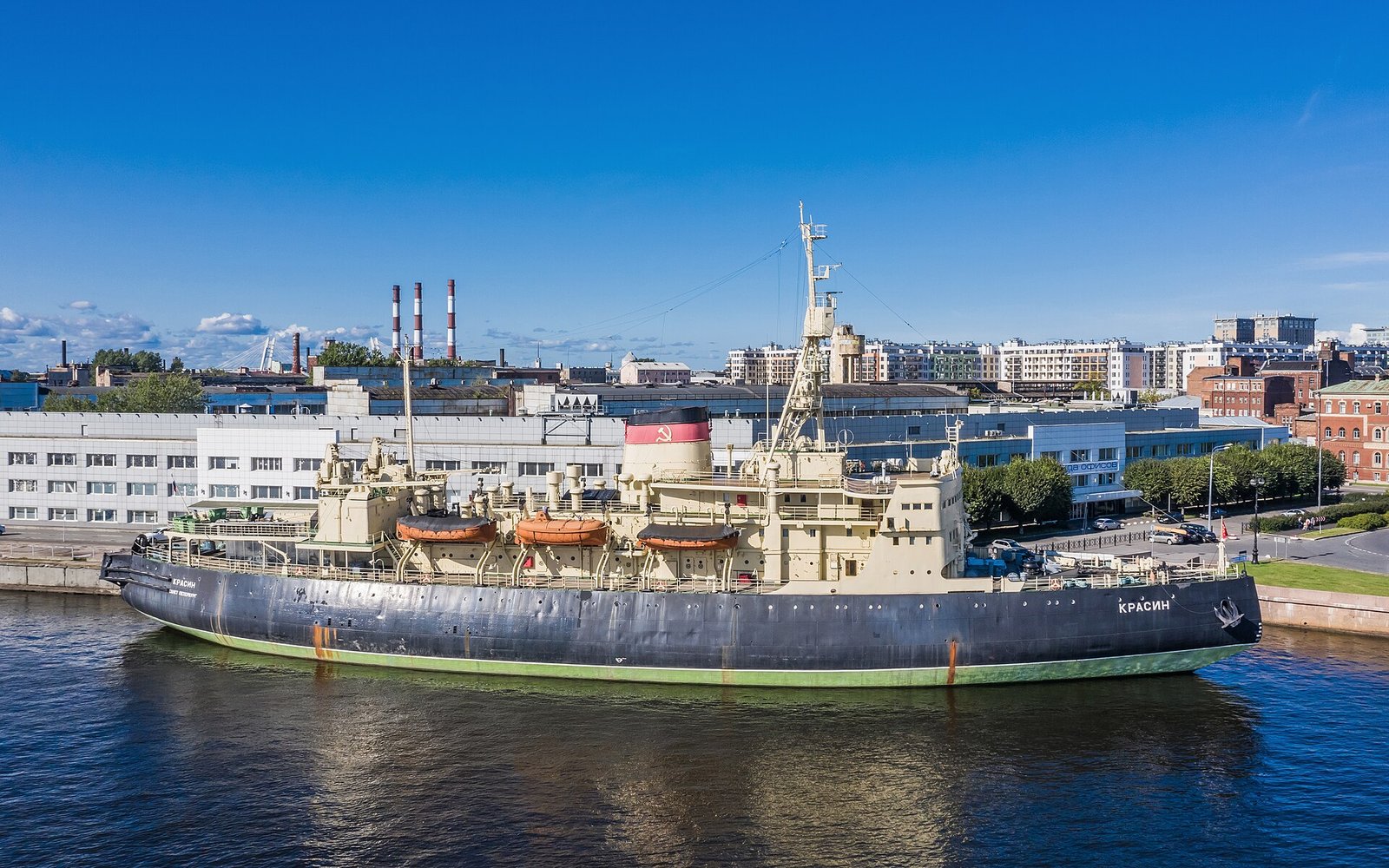
The icebreaker Krasin at Lieutenant Schmidt Embankment — Photo: A.Savin, Wikimedia Commons, FAL
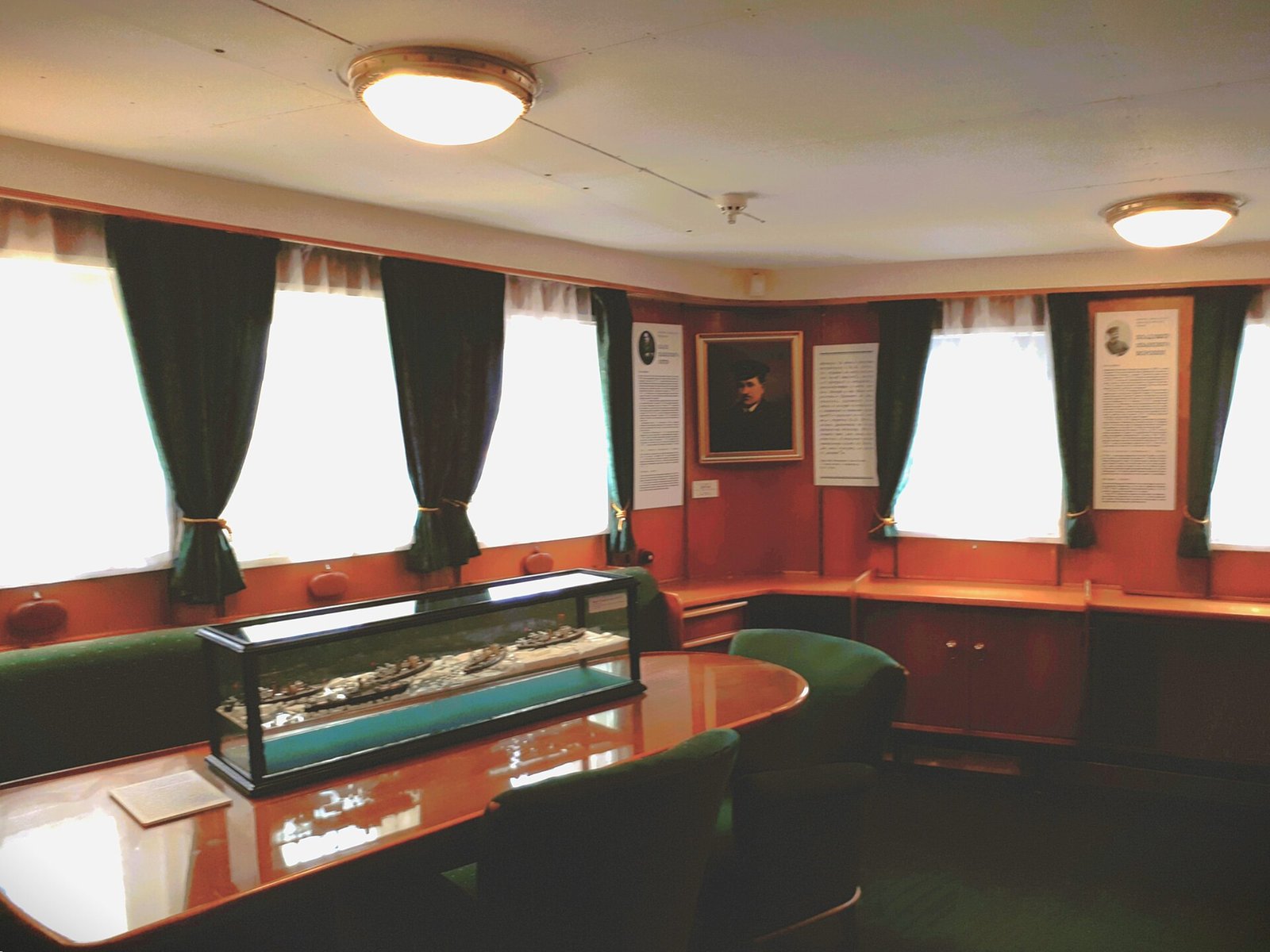
The overview tour covers the history of icebreakers, Arctic exploration, the rescue of the Nobile expedition and Krasin's part in the Arctic convoys of the Second World War. The route includes the wardroom, the captain's cabin and the captain's bridge with the wheelhouse and chart room. That is the main difference from Aurora: on Krasin you walk through the ship's living and working spaces, not just halls with display cases.
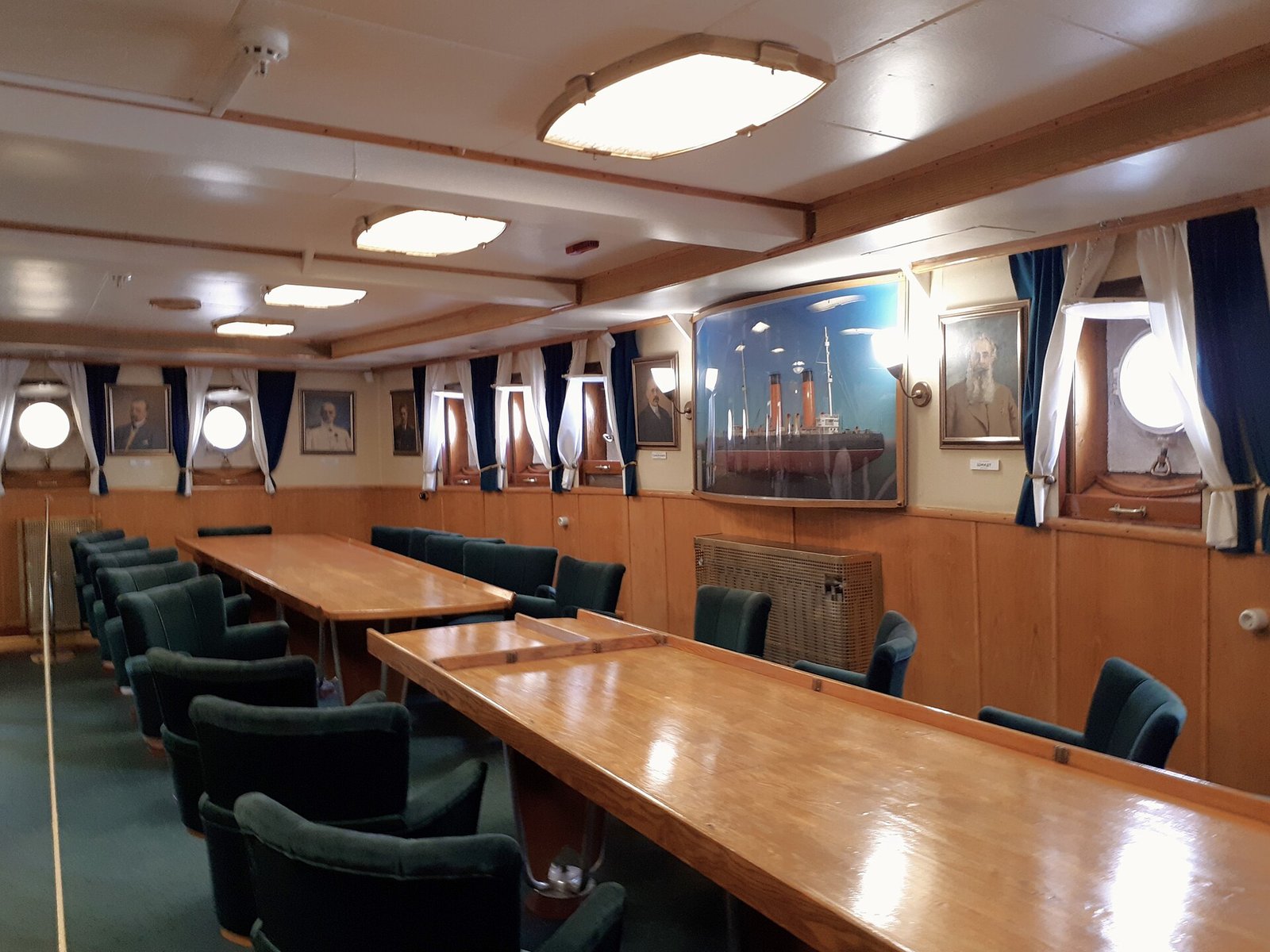
A room with long tables, portraits and a model of the icebreaker on Krasin — Photo: Aleksandrovy AG, Wikimedia Commons, CC BY-SA 4.0
A separate tour, "Heart of the Ship" (Serdtse korablya), goes down into the engine and boiler rooms: steam boilers and a triple-expansion steam engine. Strictly 14 and over, with ID proving age.