Piter Pass
Blog
The Russian Museum of Ethnography in St Petersburg: the Marble Hall, the halls of Russia's peoples, tickets and free days

The Russian Museum of Ethnography in St Petersburg: the Marble Hall, the halls of Russia's peoples, tickets and free days

AS

by Anna Shaposhnikova

6 min read•October 27, 2026
🖼️Museums & Palaces

If you want to spend National Unity Day somewhere that is actually about unity, St Petersburg has the obvious address: the Russian Museum of Ethnography on Inzhenernaya Street. Under one roof it gathers the costumes, homes, jewellery and festivals of dozens of peoples of Russia and its neighbours — and 2026 has been declared the Year of Unity of the Peoples of Russia. It is also one of the most beautiful buildings in the centre: plenty of people have seen photos of its pink marble hall under a crystal ceiling without knowing where it is.

4 November 2026 is a Wednesday, and the museum is open. Below: what to see, tickets and free days, all checked on the museum's website on 19 October 2026.

🏛 The Marble Hall: columns, crystal and 183 figures

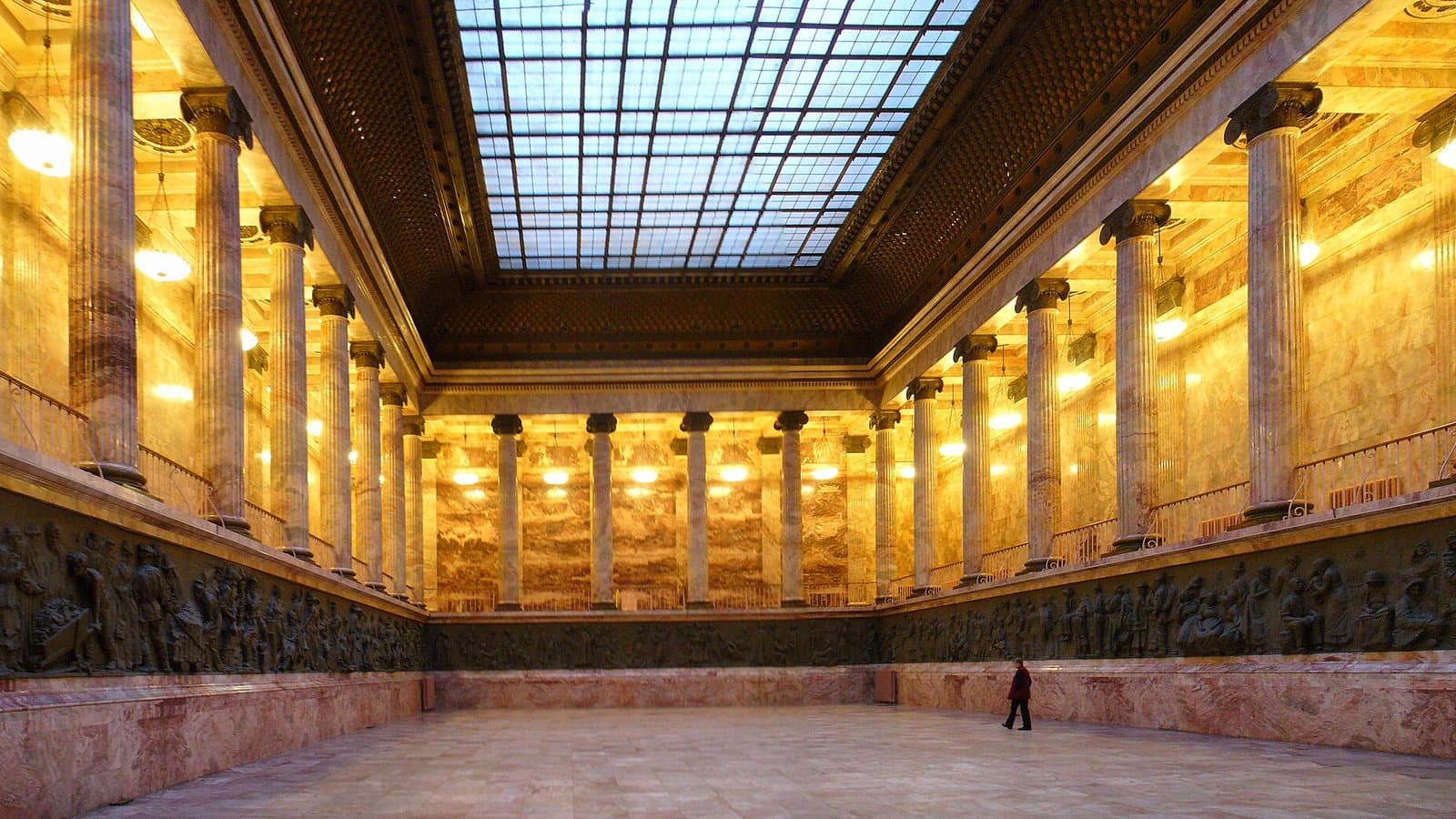
The Hall in Memory of Emperor Alexander III, now known as the Marble Hall, is described by the museum itself as unique in St Petersburg architecture. It covers about 1,000 square metres and rises 15.7 metres, ringed by 28 columns weighing 24 tonnes each. The pink marble came from the Tivdia quarries in Karelia — the architect, Vasily Svinyin, travelled to the quarry to pick the blocks himself.

The colonnade of the Marble Hall at the Russian Museum of Ethnography under its glass ceiling

The colonnade and gallery of the Marble Hall — Photo: Aleksandrovy AG, CC BY-SA 4.0, Wikimedia Commons

The ceiling is made of crystal tiles produced by the Moscow jewellers Khlebnikov. They were shattered in the war and replaced with ordinary glass in the 1950s; only the restoration of 2009–2011 brought the crystal back. The column capitals carry the Romanov coat of arms and Alexander III's monogram.

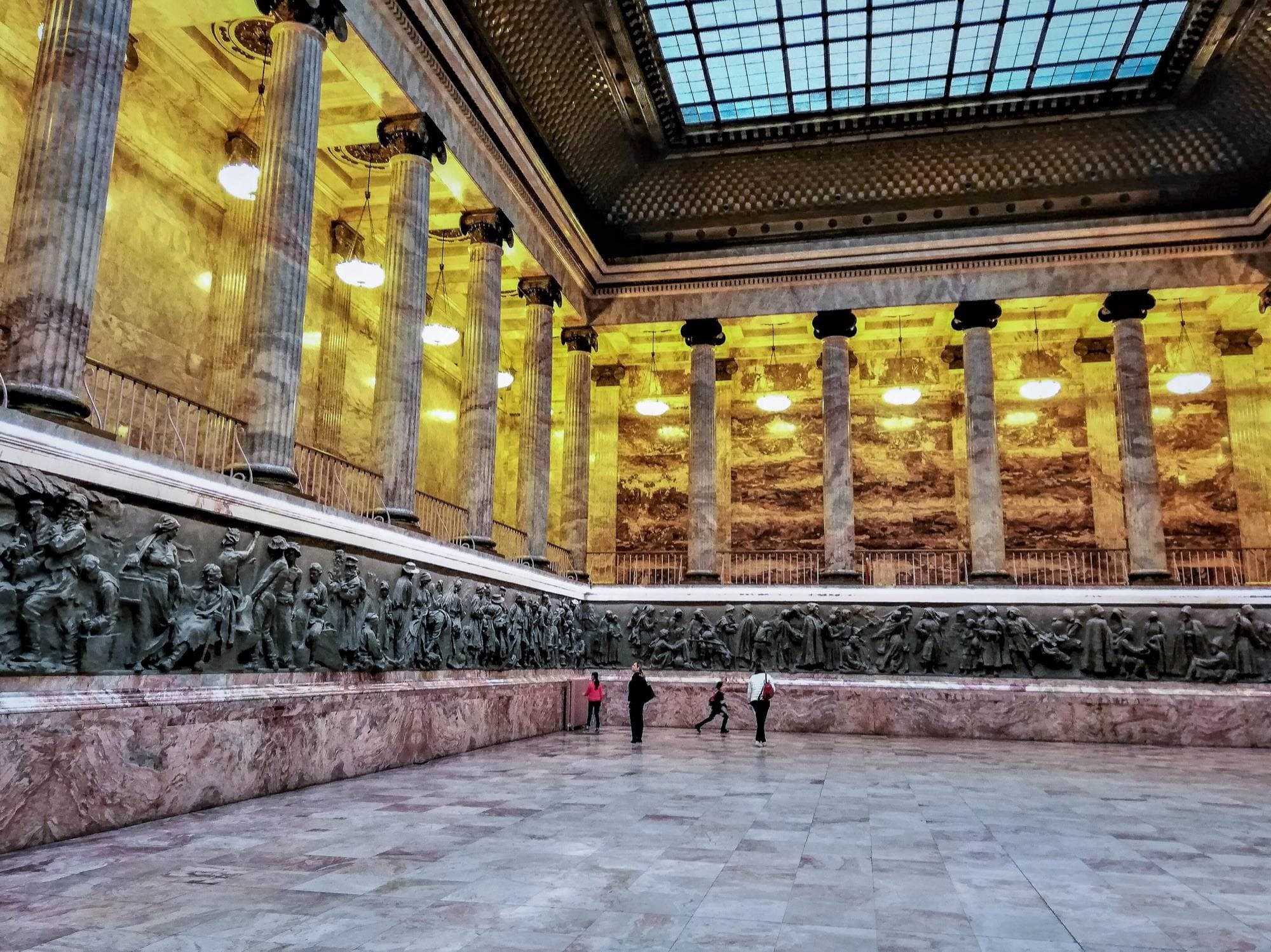
The real highlight, though, is the sculpted frieze. Ninety-six metres long and 1.87 metres high, it runs along three walls at eye level, with 183 figures showing scenes from the life of the peoples of the Russian Empire. It is the work of the sculptors M. Ya. Kharlamov and V. S. Bogatyryov. Walk along it slowly: women carrying sheaves, musicians, children, carts — every scene tells its own story.

Detail of the Marble Hall frieze: peasants, a fiddler and a boy by a cart wheel

Detail of the Marble Hall frieze — Photo: Aleksandrovy AG, CC BY-SA 4.0, Wikimedia Commons

For the full story there is an audio tour of the hall, "Bronze, Marble and Crystal" (45 minutes, 300 roubles on top of admission). One caveat from the website: the Marble Hall may be closed on event days, so check by phone on +7 (812) 570-54-21.

🧱 Svinyin's building: a portico crowned by Athena

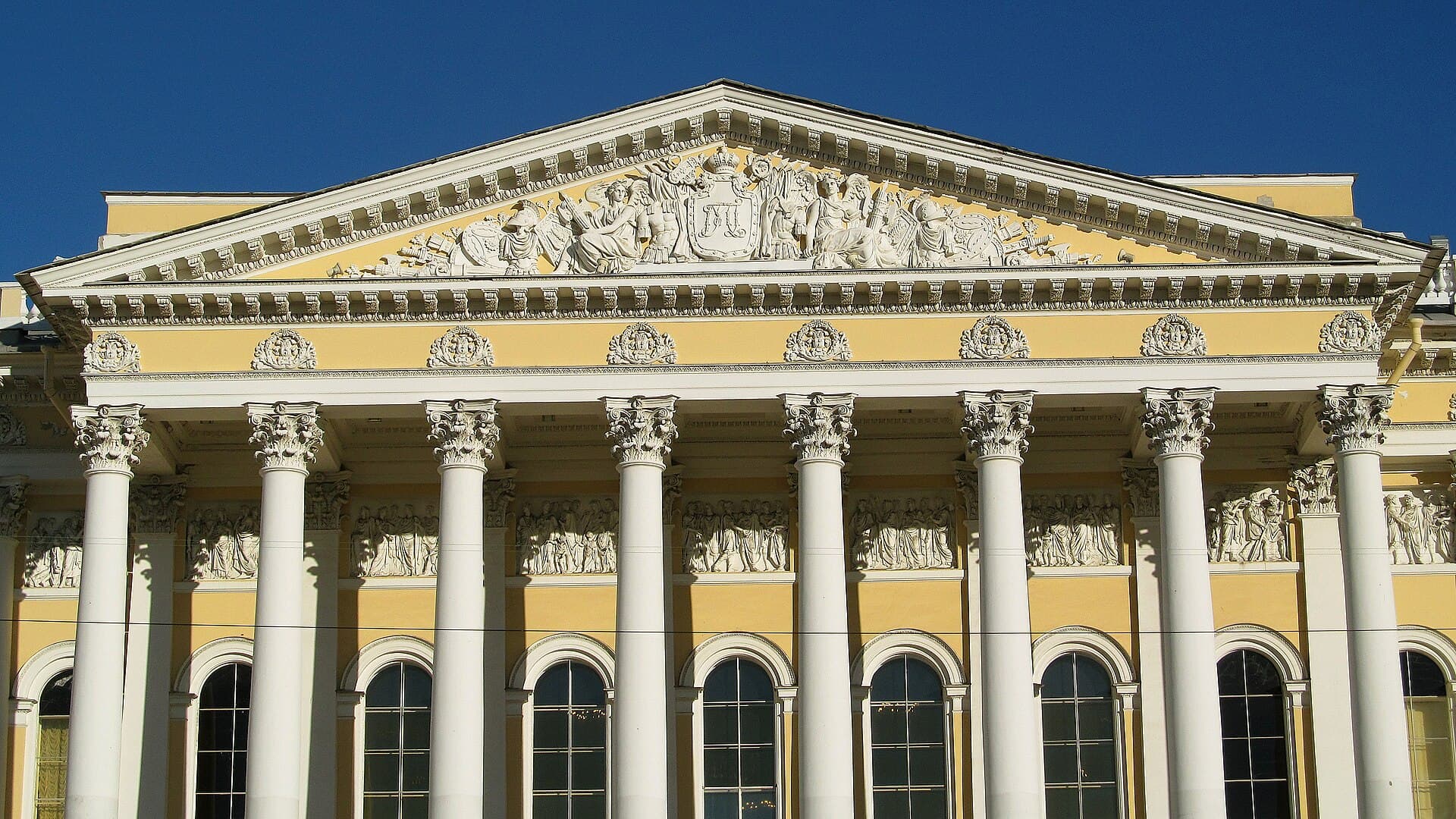
The museum began life as the Ethnographic Department of the Russian Museum of Emperor Alexander III, and this building was designed for it: the foundation stone was laid on 16 June 1905 and the interiors were finished in early 1916. Only half of Svinyin's plan was ever built — after the Russo-Japanese War, money ran out once the main wing and part of the courtyard wings were up.

Facade of the Russian Museum of Ethnography on Inzhenernaya Street

The museum's facade on Inzhenernaya Street — Photo: Dezidor, CC BY 3.0, Wikimedia Commons

Look up before you go in. The frieze is packed with wreaths, pharaoh masks, books, scrolls and the arms of the Empire, Moscow and St Petersburg, while reliefs of ancient philosophers and scholars flank the entrance. The group "Athena, Patron of the Arts and Crafts" was placed on the portico in 1910.

🏠 "Russians": a peasant house, a stove and festivals

From the Marble Hall, head into the permanent displays. The most detailed is "Russians. Late 19th – Early 20th Century": how peasants farmed, built houses and stoves, made their clothes, and how the working week gave way to feast days.

Interior of a peasant log house with a Russian stove in the museum's display

A peasant house in the museum's display — Photo: Aleksandrovy AG, CC BY-SA 4.0, Wikimedia Commons

These rooms have a free augmented-reality guide on the Artefact platform, and there is a free audio guide to all the displays on tmatic.travel.

👘 The halls of peoples: from the Arctic to Central Asia

Next come the displays on Russia's neighbours and regions. The website currently lists nine: "Belarusians", "Ukrainians", "Moldovans", "Peoples of the Volga and the Urals", "Peoples of North-West Russia and the Baltics", "Peoples of the South Caucasus", "Peoples of Central Asia and Kazakhstan", "The Arctic — Inhabited Land" and "Bone, Horn, Amber". Each room has costumes, household objects and dwellings, along with answers to questions such as why the yurt suits nomads so well, and how Nowruz and Sabantuy were celebrated.

Folk costumes in display cases in the permanent exhibition

Folk costumes in the permanent exhibition — Photo: Aleksandrovy AG, CC BY-SA 4.0, Wikimedia Commons

Some displays sit in two-storey halls under glass roofs, with cases and installations on the floor and a gallery running round the top. Climb up at least once — from there you see the whole room at a glance.

A two-storey hall of the museum under a glass roof

A two-storey hall under a glass roof — Photo: Artyom Svetlov, CC BY 4.0, Wikimedia Commons

Short-term rentals in Saint Petersburg

Лофт у реки Мойки

8 000 ₽ per night · ≈ $99 · ★ 4.82

3 nights · 24 000 ₽ total · ≈ $298

See options

at the Bank of Russia rate on 27.10.2026 · powered by tutkakdoma

💎 The Special Storeroom: gifts to the emperors

"Treasures of the Special Storeroom" is a strongroom holding the museum's most precious pieces: jewellery, ceremonial weapons, horse trappings and diplomatic gifts. Among them are weapons and harness from the gifts of the Emir of Bukhara, Buddhist ritual objects presented by Kalmyk and Buryat delegations, and bread-and-salt dishes by Russian jewellers. Next door, "Bone, Horn, Amber" shows carving by northern craftsmen.

A carved bone scene with reindeer sledges

Bone carving: a northern scene with reindeer sledges — Photo: Aleksandrovy AG, CC BY-SA 4.0, Wikimedia Commons

🗓 Autumn 2026 exhibitions and the 4 November programme

Temporary exhibitions running in early November:

— "Peoples of Crimea", until 31 December 2026: more than 250 objects, including costumes of the Crimean Tatars, Krymchaks, Greeks, Bulgarians, Russians and Ukrainians, crafts and textiles.
— "Land of the Golden Mountains", marking 270 years since the Altai people joined the Russian state, until 13 March 2027: a shaman's costume, musical instruments and works by the painter Grigory Choros-Gurkin.
— "Weapons: Symbol, Amulet, Protection", until 28 February 2027, with more than 400 objects.
— "Gifts of the Caucasus" and "Faith. Learning. Law: the Religious Culture of the Jewish People", until 31 December 2026.

According to the website, all five are included in the standard admission ticket. Also open until the end of the year are "Peoples of the Great Steppe: Buryats and Kalmyks", "The World of Chuvash Culture" and "Living Water: Folk Brewing Traditions", and until 8 November there is a "Children's Days" family festival with a trail game. As of 19 October the museum's listings show no special programme for 4 November, and no "Night of the Arts" has been announced for St Petersburg — that event is a Moscow tradition. If a programme appears, it will be on ethnomuseum.ru.

🎟 Opening hours, tickets and free days

The address is 4/1 Inzhenernaya Street, a short walk from Nevsky Prospekt and Gostiny Dvor metro stations. Opening hours: Tuesday 10:00–21:00 (ticket office until 20:00), Wednesday to Sunday 10:00–18:00 (ticket office until 17:00), closed on Mondays; entry is by half-hourly time slots. So the museum is closed on 2 November, you can come in the evening on the 3rd, and on the 4th it keeps its usual Wednesday hours — as of 19 October the website announced no holiday changes.

The museum's entrance hall with marble walls and a moulded vault

The entrance hall — Photo: Artyom Svetlov, CC BY 4.0, Wikimedia Commons

Ticket prices as of 19 October 2026: 600 roubles for adults; 250 for pensioners and 300 for students from Russia and the Eurasian Economic Union (EAEU) countries; 200 for children aged 7 to 16; and 1,200 for a family ticket covering up to four people with children under 16. Children aged 6 and under go free, and the Pushkin Card is accepted. Online, tickets are sold only through the museum's official website.

Free days: on the third Sunday of each month for everyone under 18 and for pensioners from Russia and the EAEU (15 November this time), and on the first Thursday for students of Russian universities and colleges (5 November). More free museum days around the city are in our guide "St Petersburg museums for free: when to go".

Photography is allowed without flash, tripods or selfie sticks, except where signs say otherwise. The cloakroom is on the lower ground floor; the café and gift shop are on the ground floor and need no ticket. Allow two to three hours.

🧭 Nearby

The museum stands right next to the Mikhailovsky Palace of the State Russian Museum, with the Mikhailovsky Garden behind them both. And if you want the cultures of the whole world rather than just Russia, the Kunstkamera is across the river on Vasilyevsky Island — here is our Kunstkamera guide.

📌 In short

✅ 4/1 Inzhenernaya Street; Nevsky Prospekt and Gostiny Dvor metro.

✅ The star is the Marble Hall: 28 columns, a crystal ceiling and a 96-metre frieze. It may close on event days.

✅ Tue 10:00–21:00, Wed–Sun 10:00–18:00, closed Mondays. Open on 4 November, closed on 2 November.

✅ Tickets 600 roubles; free for children 6 and under, for under-18s and pensioners on the third Sunday, and for students on the first Thursday.

✅ "Peoples of Crimea", "Land of the Golden Mountains" and "Gifts of the Caucasus" are included in admission; no 4 November programme yet.

A museum where the Arctic, Altai and Crimea meet under one ceiling is arguably the most fitting place in St Petersburg to spend 4 November.

Checked on ethnomuseum.ru on 19 October 2026. Opening hours may change — check before you go.

Cover photo: Aleksandrovy AG, CC BY-SA 4.0, Wikimedia Commons.

Previous postNext post

Getting around Saint Petersburg

Airport (Pulkovo) and around-town transfers — fixed price, meet-and-greet driver.

Find a transfer

powered by rideclu.ru

You may be interested

Museum of Ethnography or Kunstkamera: how they differ, which to choose and how to see both in a day

Museum of Ethnography or Kunstkamera: how they differ, which to choose and how to see both in a day

The Russian Museum of Ethnography covers the peoples of Russia and has the Marble Hall; the Kunstkamera covers the world...

Blog
October 21, 2026
The Russian Museum in St Petersburg: tickets, opening hours, free days and a two-hour route

The Russian Museum in St Petersburg: tickets, opening hours, free days and a two-hour route

The Russian Museum is five buildings in the centre of St Petersburg, and each has its own ticket. We explain what is whe...

Blog
October 13, 2026
130 years of Evgeny Shvarts: the exhibition at the Marble Palace of the Russian Museum

130 years of Evgeny Shvarts: the exhibition at the Marble Palace of the Russian Museum

In 2026 Evgeny Shvarts turns 130. The Russian Museum marks the anniversary with an exhibition at the Marble Palace: the ...

Blog
October 26, 2026