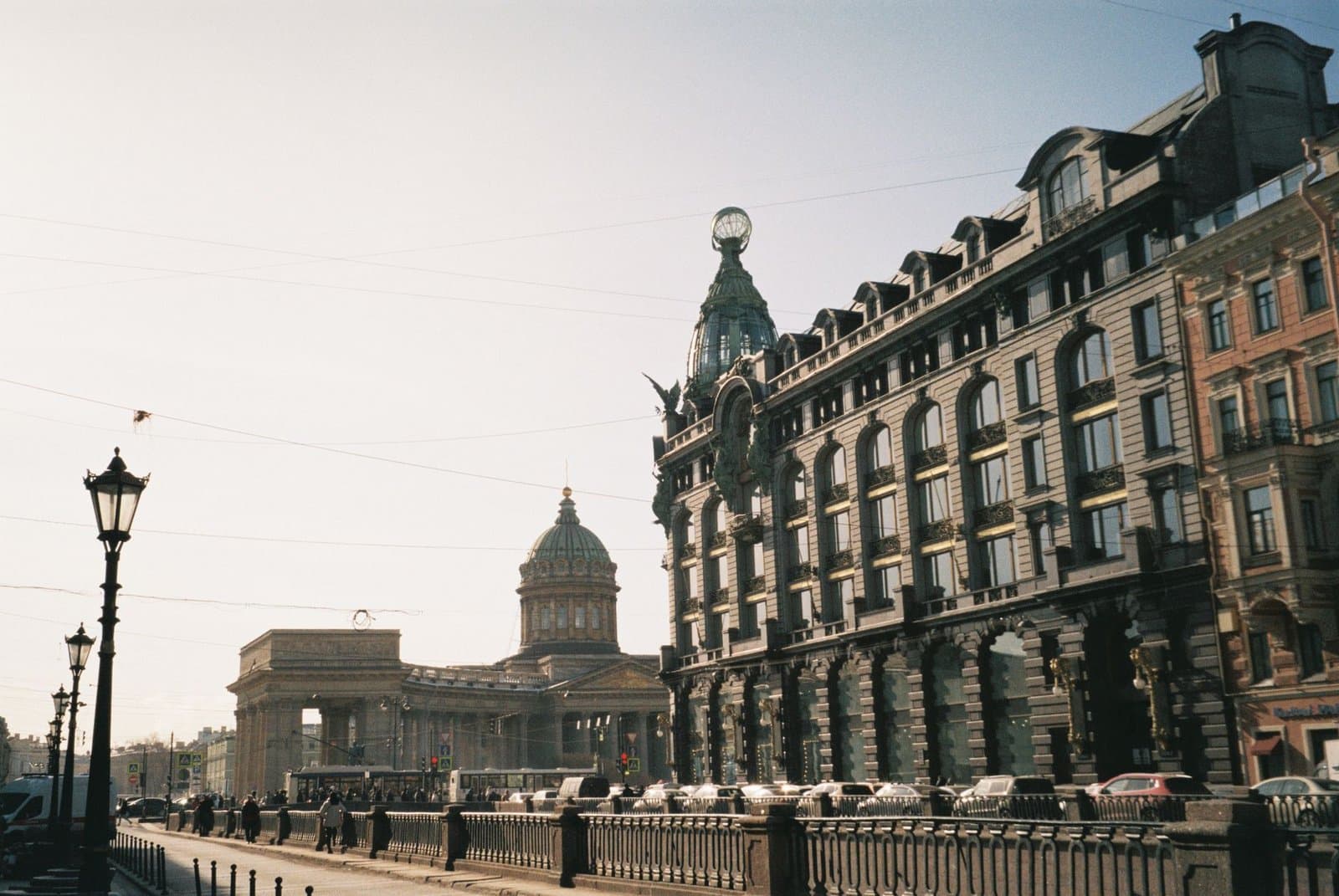
Anichkov Bridge carries Nevsky Prospect over the Fontanka River and is one of Saint Petersburg's most photographed crossings, thanks to the four bronze Horse Tamer groups by Pyotr Klodt that stand at its corners. It is free, always open, and right in the heart of the city.
Why is the Anichkov Bridge famous?
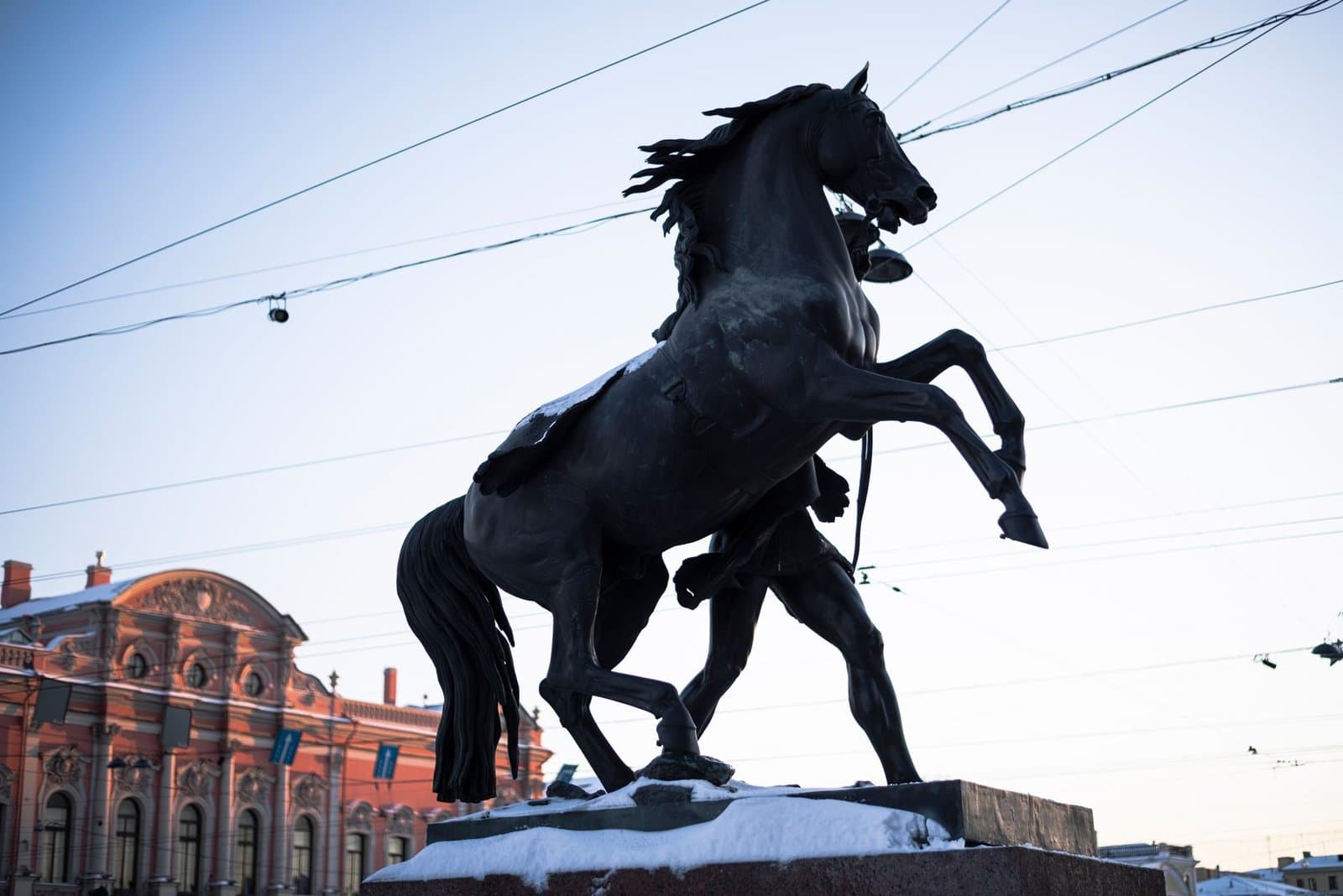
The bridge is famous less for its engineering than for its sculpture. At each of its four corners stands a bronze group known collectively as the Horse Tamers (or the Taming of the Horse), created by the sculptor Pyotr Klodt and installed between 1841 and 1850. Together they turn an ordinary river crossing on the city's main avenue into an open-air work of art that visitors stop to admire day and night.
The setting adds to the appeal. The bridge spans the Fontanka exactly where Nevsky Prospect crosses it, with the pink Beloselsky-Belozersky Palace on one side and the Anichkov Palace grounds on the other, so the statues are framed by some of the finest architecture on the avenue.
How old is the Anichkov Bridge?
There has been a crossing here since the very first years of the city. The original was a wooden bridge built in 1715–16; a stone bridge with towers followed in the 1780s as the Fontanka was embanked. The version you see today dates from an 1841–42 rebuilding that widened the roadway for Nevsky's growing traffic — the same works that created the pedestals for Klodt's statues — and it was reconstructed again in 1906–08, with further repairs into the modern era.
What do the Horse Tamers statues represent?
The four groups tell a single story in stages: the gradual taming of a wild horse by a man. Read around the bridge, they move from the animal's first resistance to its eventual submission, a theme often understood as human reason and will mastering raw natural force. Each group is different, so it is worth walking all four corners to follow the sequence.
Sculptural group
What it shows
Group 1
A rearing horse held back by a youth still on the ground — the struggle begins
Group 2
The horse breaking free as the tamer is thrown down — the animal at its wildest
Group 3
The man rising and regaining control — the balance starts to shift
Group 4
The horse subdued and led by the standing tamer — reason prevails
The interpretations above reflect the traditional "stages of taming" reading of the groups; the sculptures themselves carry no inscriptions, so descriptions vary slightly from guide to guide.
Pyotr Klodt (1805–1867) was one of Imperial Russia's leading animal sculptors, famous above all for horses. Beyond the Anichkov groups, his work includes the horses on the Narva Triumphal Gate, the monument to the fable-writer Ivan Krylov in the Summer Garden, and the equestrian statue of Nicholas I on St Isaac's Square. He ran his own foundry, which let him cast the Horse Tamers — and later their copies — himself.
at the Bank of Russia rate on 24.10.2026 · powered by tutkakdoma
Are there copies of the Horse Tamers elsewhere?
Yes. Klodt cast repeats of the groups that were given as diplomatic gifts and reused at other sites. Versions were presented to the King of Prussia and stand in Berlin, and to the King of the Two Sicilies in Naples; further casts were placed at the imperial estates of Peterhof and Strelna near Saint Petersburg. That is why travellers sometimes feel they have seen the horses before — related casts really do stand in several countries.
Who was the Anichkov Bridge named after?
Despite sounding like the girl's name "Anya", the bridge is named after Mikhail Anichkov, an 18th-century military engineer whose battalion built the first wooden crossing here in 1715–16, in the reign of Peter the Great. The stone-and-bronze bridge you see today is the result of later rebuildings, but the original engineer's family name has stayed with it for three centuries.
During the Siege of Leningrad in the Second World War, the Klodt groups were taken down and buried in the garden of the nearby Anichkov Palace to protect them from shelling, then returned to their pedestals after the war. Look closely at the granite plinths and you can still find damage left by artillery fragments, marked by a small memorial plaque that deliberately preserves the scars.
How do you get to the Anichkov Bridge?
The bridge is on Nevsky Prospect itself, so it is one of the easiest sights to reach. The closest metro stations are Gostiny Dvor and Mayakovskaya, both a short walk along the avenue. It also pairs naturally with a stroll down Nevsky or a boat trip on the Fontanka. For lines, fares and tips, see our Saint Petersburg metro guide.
What else is nearby?
You are in the middle of the city's grandest promenade. The Beloselsky-Belozersky Palace stands right at the bridge, the shops and arcades of Nevsky are on either side, and the delicate Bank Bridge with its golden-winged griffins is a short walk away. For more crossings worth seeking out, see our guide to Saint Petersburg's most beautiful bridges.
Yes. Anichkov Bridge is a public crossing on Nevsky Prospect, so there is no ticket and no opening hours — you can view all four Horse Tamer groups at any time, day or night. The statues are floodlit after dark, which makes an evening visit especially atmospheric on your way to or from dinner on the avenue.
Can you walk across the Anichkov Bridge?
Absolutely. The bridge carries both traffic and wide pavements, so you can walk across it and around all four corners to see each sculptural group up close. It is fully part of the Nevsky Prospect walking route, and crossing on foot is the best way to appreciate how the statues frame the Fontanka.
Is there a hidden image on one of the horses?
A popular local legend claims a human face is worked into the anatomy of one of the horses, supposedly a dig at a rival. There is no documentary proof, and it is best treated as folklore rather than fact — but it is the kind of story guides love to point out, and it adds to the fun of inspecting the bronzes closely.
Seeing Nevsky properly? A city pass bundles skip-the-line entry to the museums and palaces along the avenue, and a guided Nevsky Prospect walking tour or Fontanka boat trip is a relaxed way to take in the bridge and its statues with commentary.