The classic last-day scenario: a train in the evening, and a visitor panic-buying fridge magnets, dubious "amber" and a matryoshka on Nevsky Prospekt. A week later the magnet has fallen off the fridge, the amber turns out to be plastic, and the matryoshka lives in a cupboard. Worse is when the purchase gets taken away at security, or cannot legally leave the country at all.
Edible things that survive the trip
Pyshki, the local ring doughnuts, do not travel. They are food with a fifteen minute lifespan, eaten standing up with coffee. Smelt, the spring fish every local waits for, travels only dried or smoked and tightly wrapped; fresh smelt in a suitcase is a problem for you and everyone around you. Seasonal dates shift every year, so ask at a fish counter what is actually local right now instead of trusting a sign.
The safe bets are chocolate and sweets from the city's confectionery factories, plus jam, tea and gingerbread from ordinary city markets rather than souvenir stalls, where the same bar costs twice as much because of the tin.
Imperial Porcelain
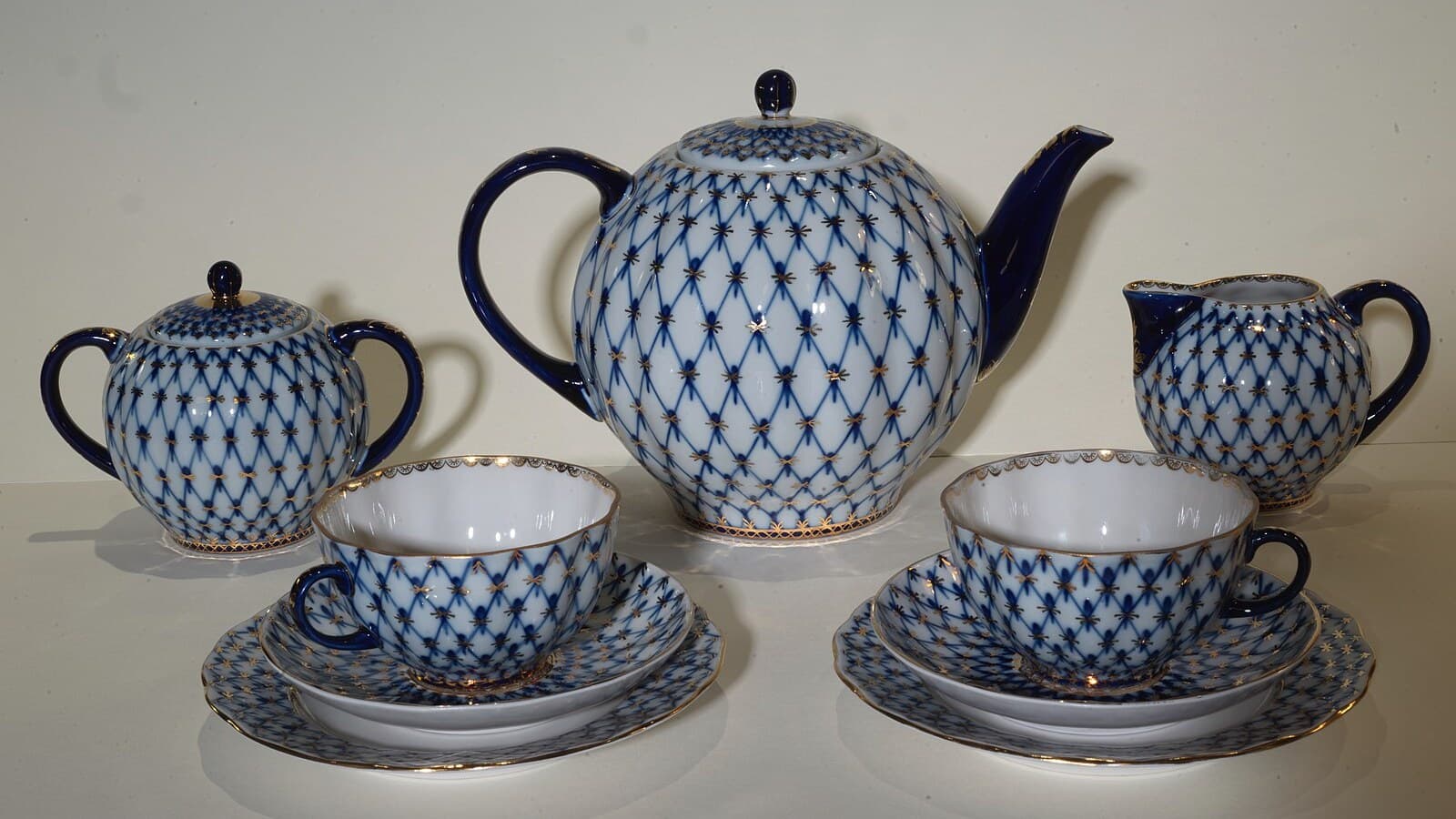
The most genuinely local gift. The Imperial Porcelain Factory was founded in 1744 and still works on the same site at 151 Obukhovskoy Oborony Prospekt, metro Lomonosovskaya, where its own shop, Imperial Porcelain No. 1, is open daily from 10:00 to 20:00 according to the company website. The recognisable pattern is the cobalt net, designed by the artist Anna Yatskevich in 1944 for the factory's 200th anniversary; the factory says the pattern now appears on more than a hundred different items.
Prices differ between the brand shops. In the centre there is No. 2 at 7 Vladimirsky Prospekt (daily 10:00 to 21:00) and No. 4 at 153 Nevsky Prospekt. There is also a discount shop, No. 5, at 38 Babushkina Street near the same Lomonosovskaya metro, open 10:00 to 20:00. For one cup as a present, start there. The factory museum, founded in 1844, has been managed by the State Hermitage since February 2001 and holds over thirty thousand objects; it is closed on Mondays and open from 11:00, with the ticket office closing at 17:00. Half an hour there teaches your eye to tell factory work from a market imitation.
Museum shops and bookshops
Museum shops sell what souvenir stalls do not: print reproductions, albums, postcards of specific objects from the collection, scarves and umbrellas with real design. Bookshops are the other underrated option. An art album or a local history book is heavy but outlives any magnet.
What you are not allowed to take out
Russian law No. 4804-I of 15 April 1993 on the export and import of cultural property lists, in Article 9, what may not leave the country. One item concerns every antique buyer: cultural property created more than 100 years ago. The same article covers objects protected by the state and entered in official registers, and anything permanently held in state museums, archives and libraries.
Expert assessment can classify as cultural property works of art and objects of religious worship (icons), manuscripts, archives, coins and medals, uniforms and equipment, antique weapons, and old orders and decorations. Export by a private person requires a permit document from a territorial office of the Ministry of Culture, and the object must be declared in a passenger customs declaration. The assessment is paid, and a state fee applies. Printed matter, souvenirs and coins made less than 50 years ago need no permit, so a new cup, a book and a box of chocolates are of no interest at the border.
Liquids and fish on the plane
Pulkovo Airport states that hand luggage may contain liquids, gels and aerosols in containers of no more than 100 ml, packed in a transparent resealable plastic bag of up to one litre. Anything in a larger container travels in checked baggage only. Duty free purchases may be carried into the cabin if sealed at the till in a plastic bag together with a receipt from the same day.
For fish it is about packing. Clause 128 of Russian Federal Aviation Rules No. 82 requires every piece of checked baggage to be packed so that it stays intact during handling; baggage that fails this is not accepted. In practice: vacuum pack or double seal it, then bury it between clothes. The airline Rossiya states in its carriage rules that it takes no responsibility for perishable food placed in checked baggage, allows up to 2.5 kg of dry ice per passenger for cooling it, and refuses live fish that has to travel in water. Check your own carrier's rules before buying three kilos of smoked fish.
Фото: Hannes Grobe / Wikimedia Commons, CC BY 4.0