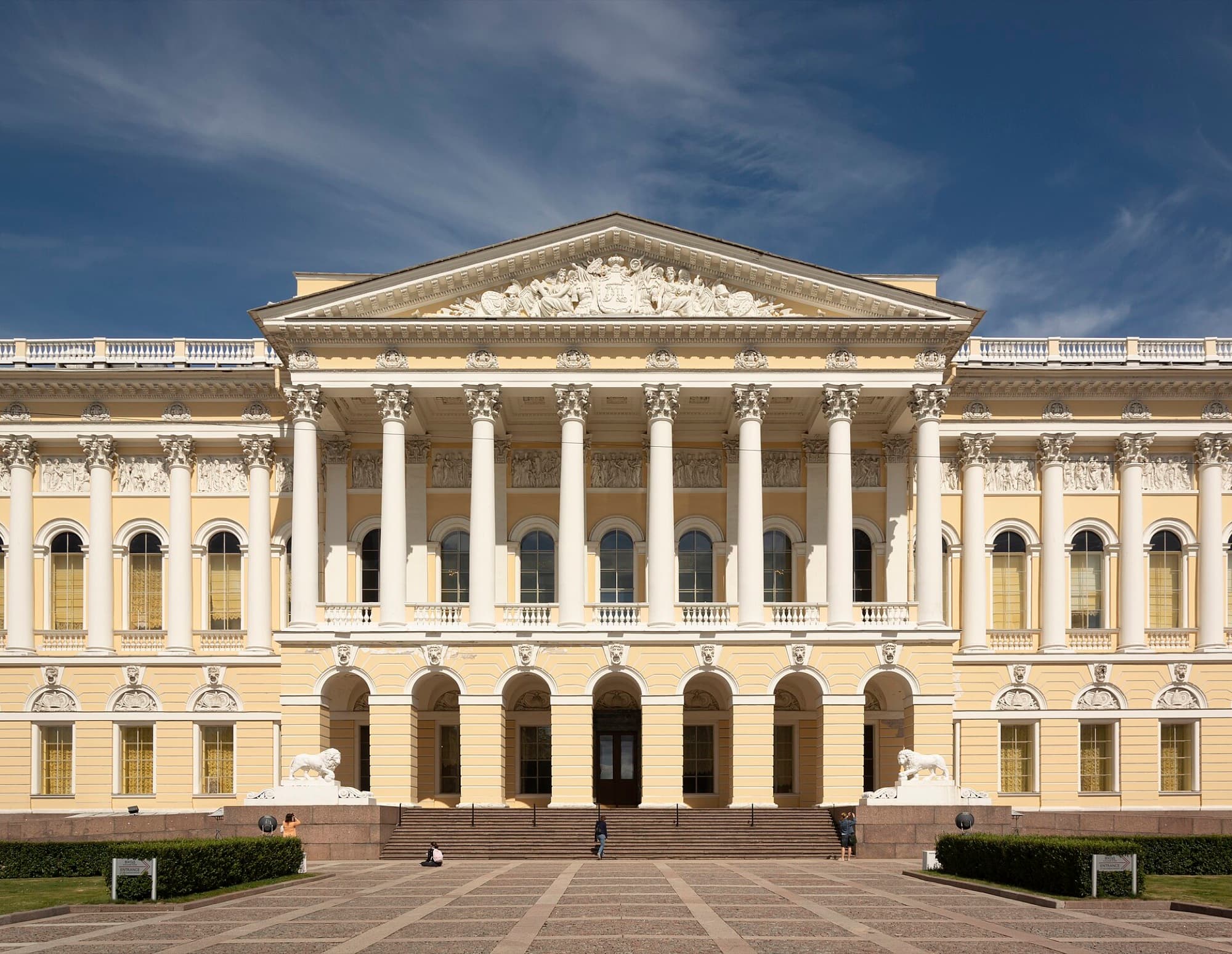
If you are in St Petersburg and thinking of a weekend in Moscow, an exhibition at the Tretyakov Gallery might be the best excuse: it is built around 17 works by Léon Bakst lent by the Russian Museum here, plus two paintings by Valentin Serov. The show marks the 160th anniversary of Bakst, a Silver Age painter, graphic artist and theatrical designer of the legendary «Saisons Russes».
Nineteen masterpieces taking a train between two cities — a good reminder that Russian collections travel rather than sit still.
Author, licence, Wikimedia Commons
What is actually on the walls
Bakst's Supper — one of his most recognisable works — still stops visitors with its enigmatic smile. Next to it hangs Ancient Terror, a large, uneasy canvas reflecting his deep interest in antiquity. Portraits of Sergei Diaghilev, Alexandre Benois and a self-portrait open up the circle of the turn-of-the-century intelligentsia and show why Bakst was one of the era's finest portraitists.
The loan covers the full range of his output: paintings, watercolours, drawings, set and costume designs — the whole span of his legacy in one room.
Author, licence, Wikimedia Commons
Why Serov is in the room
The two Serov paintings — Odysseus and Nausicaa and The Rape of Europa — open up Bakst's favourite subject: the ancient world. Both artists belonged to Mir Iskusstva (World of Art), a movement that shaped an entire era of Russian culture.
So the show is not a single-artist retrospective. It is a group portrait of a circle: its people, theatre sketches from the Ballets Russes, graphic work on classical myth. You leave with a period, not just a name.
Author, licence, Wikimedia Commons