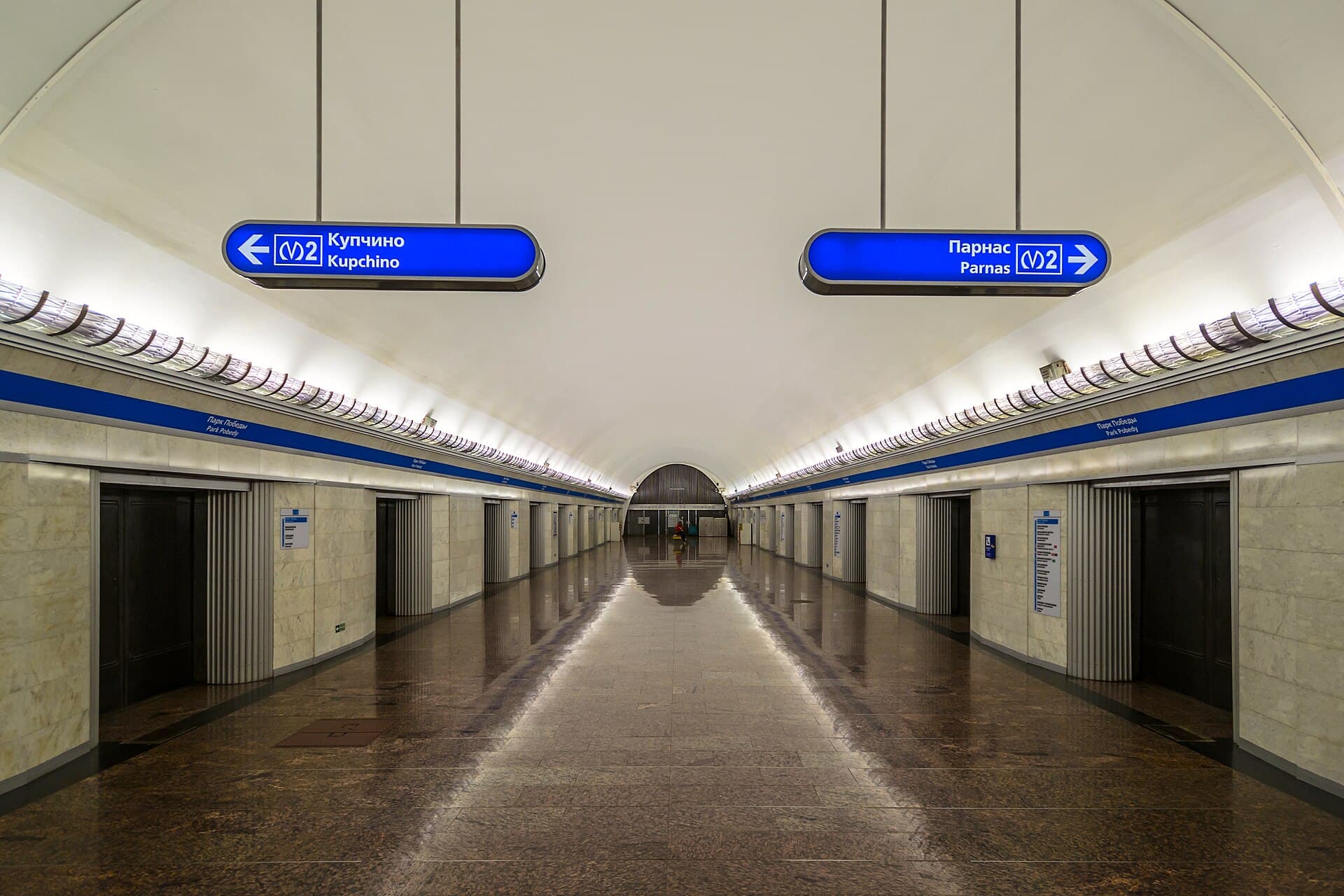
The St Petersburg metro is the deepest in the world by average station depth, and it hides two things most visitors never see: a working museum run by the operator itself, and ten Soviet-era stations with no platform at all.
The metro museum runs by appointment only
The Interactive Centre for the History of the St Petersburg Metro sits at 29 Odoevskogo Street, three minutes from Primorskaya station. The building is open daily from 09:00 to 21:00, but there is no walk-in admission: you must book a session in advance. Sessions start at 10:00, 12:00, 14:00, 16:00 and 18:00, the guided tour lasts an hour, and groups are capped at 25 people. Booking goes through the phone numbers listed on the operator's site (weekdays 09:00–18:00) or by email to [email protected], which is answered daily from 09:00 to 21:00 and is the only channel at weekends. Slots for the following month open at the start of each month, and during those days bookings are taken by phone only.
A standard ticket costs 700 roubles; the reduced rate is 500 for children aged 4 to 18, students and pensioners, and 630 with a St Petersburg citizen's card. The price includes the guide. Inside you get a cab section from a train, a station attendant's desk, a dispatcher's console, a working model where four 1960s carriages run through tunnels, and a construction cage that simulates a descent more than 70 metres down into the Cambrian clay. An English-language tour can be arranged for groups; a private visit for up to five people costs 5000 roubles.
Why the tunnels are so deep
The city stands on waterlogged sand and loam, and the only reliable layer for tunnelling is dense Cambrian clay, which lies very far down. The operator's own figures: 75 stations, six lines, 131 kilometres of track, 323 escalators. Admiralteyskaya, at about 86 metres, is the deepest station in Russia; before it opened in 2011 the record belonged to Komendantsky Prospekt at 78 metres. Entry to Admiralteyskaya runs through a cascade of two escalators, so allow several extra minutes.