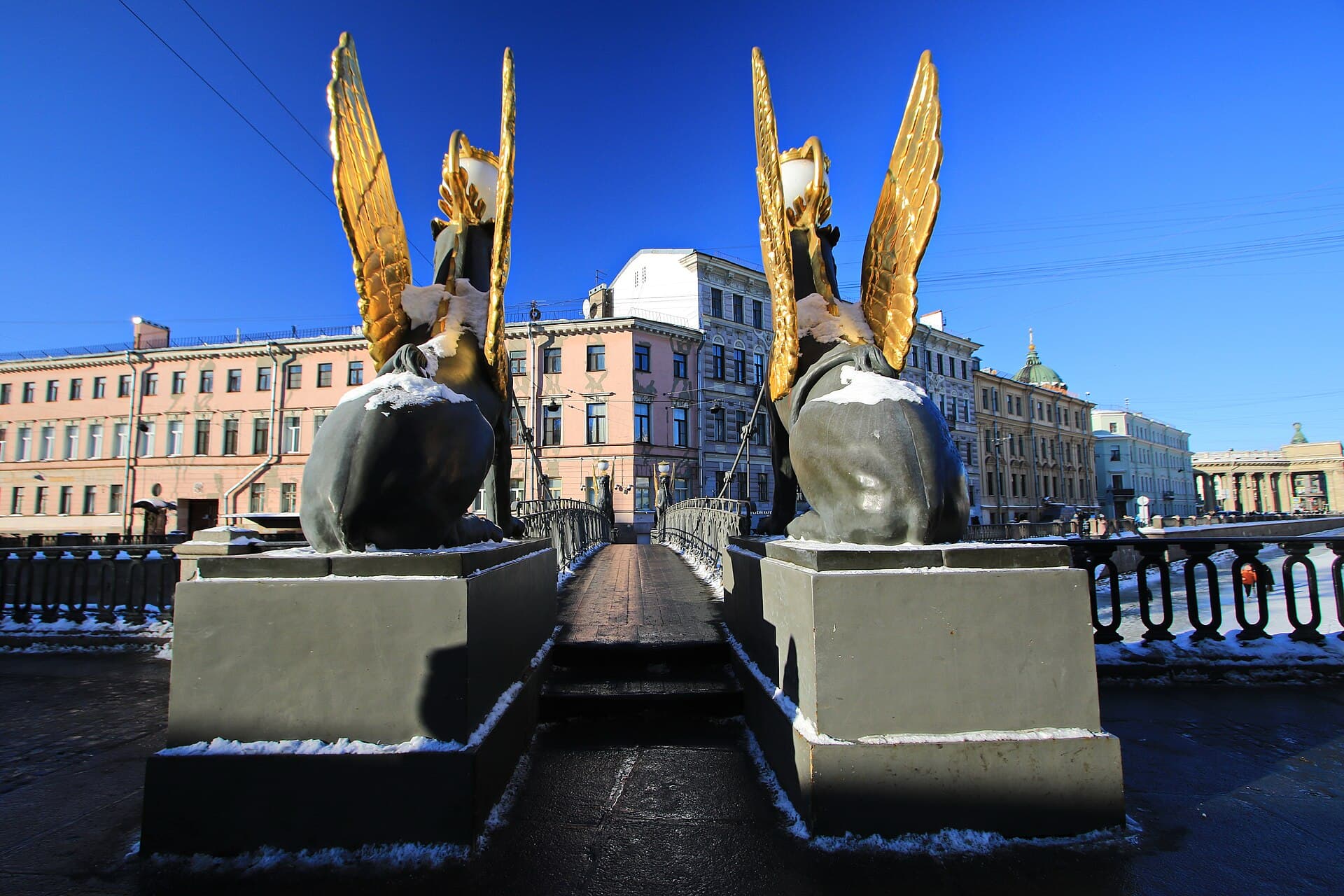
Ask what makes St Petersburg recognisable at a glance and you will get several answers, all within walking distance of one another: the angel on the spire of the Peter and Paul Cathedral, the red Rostral Columns on the Strelka, the Bronze Horseman, the golden ship above the Admiralty, the Egyptian sphinxes on the embankment and the gold-winged griffins on the Griboyedov Canal. Late October is a good time to walk them in one go: the crowds have gone, while the river navigation season and the night-time bridge openings are still on.
On 19 October 2026 we checked the history of each symbol against the Encyclopaedia of St Petersburg (encspb, the city's reference encyclopaedia), the Peter and Paul Fortress opening hours on the website of the State Museum of the History of St Petersburg, and the navigation season and bridge timetable on the website of Mostotrest, the city bridge authority. The route runs north to south, from Gorkovskaya metro to Nevsky Prospekt: about 6–7 km on the map, 3–4 hours with stops. On 23 October the sun sets at around 17:25, so start before noon.
👼 The angel on the Peter and Paul spire
Start where the city started. The Encyclopaedia of St Petersburg calls the gilded 122-metre spire of the cathedral, crowned by an angel, one of the symbols of the city — it can be seen from far away and from many streets. The stone cathedral was founded on 8 June 1712 to a design by Domenico Trezzini, and the first thing master builder van Boles put up was the bell tower with a spire clad in gilded copper and topped with the figure of an angel.

The gilded angel with a cross on the spire of the Peter and Paul Cathedral — Photo: Ad Meskens, Wikimedia Commons, CC BY-SA 4.0
The angel has a dramatic biography. In 1756 lightning struck the spire and it collapsed in flames; a new angel was made from a model by F. Eckhart. In 1829 a storm damaged the figure, and a roofer, Pyotr Telushkin, climbed up to it without scaffolding — earning a medal and a large cash reward. The nearest metro is Gorkovskaya. Hare Island (Zayachy ostrov) is open daily from 6:00 to 20:30, and the area inside the fortress walls from 9:50 to 19:30. Because of restoration work, the path along the Neva and the river-facing walls is closed (except the Commandant's Pier), and the Kronverksky Bridge has been replaced by a temporary one. What to see inside and which tickets to buy is covered in our guide Peter and Paul Fortress: tickets and route.
⚓ The Strelka: Rostral Columns, bridges and a coat of arms with anchors
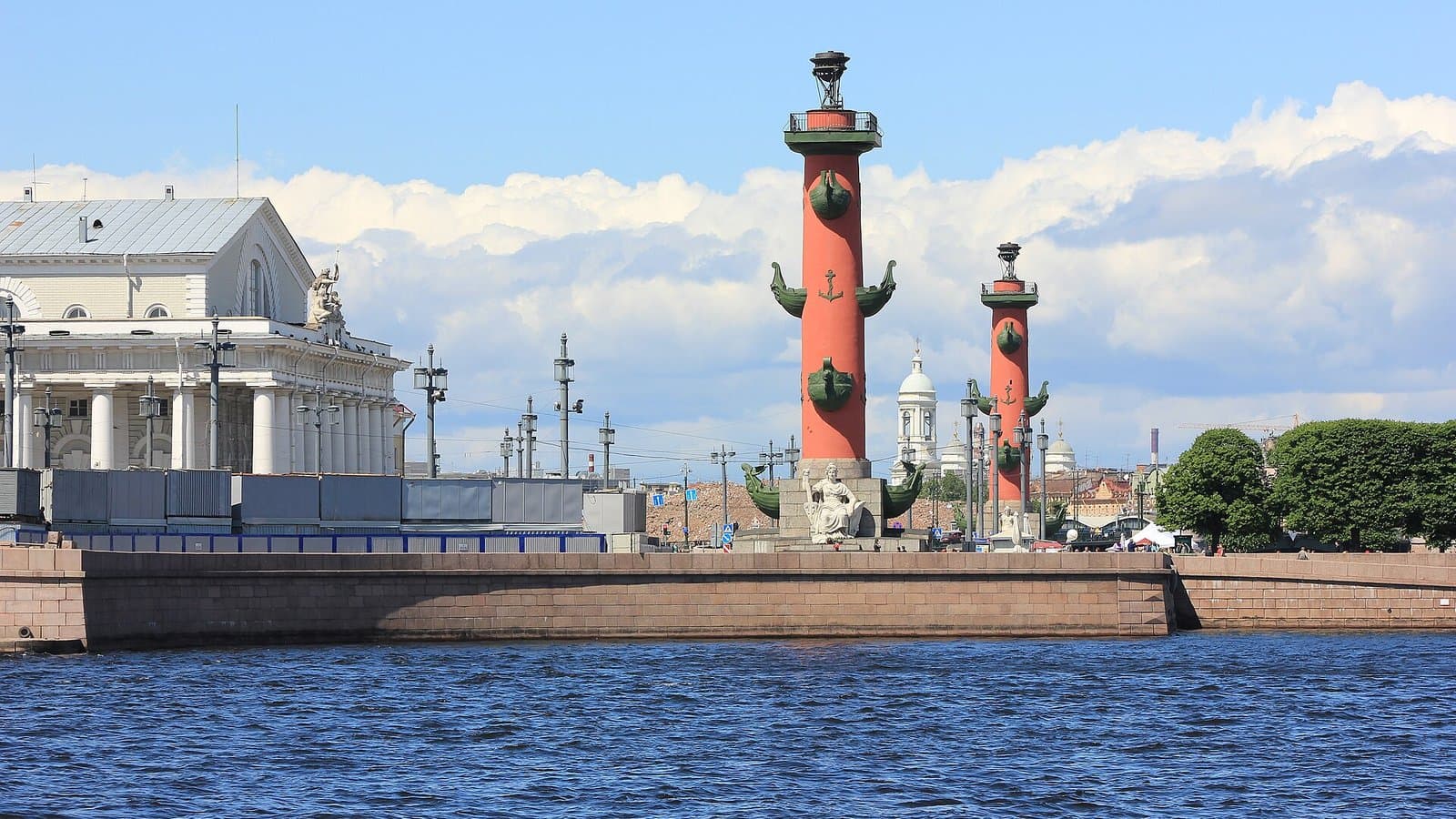
Leave the island towards Birzhevoy (Exchange) Bridge and cross to the Strelka, the eastern tip of Vasilyevsky Island. The two Rostral Columns — columns decorated with the prows of ships — were built in 1805–1810 to a design by Thomas de Thomon, from granite and Pudost limestone. They started life as lighthouses for the merchant port: spiral staircases inside lead to platforms with bowl-shaped lamps, and since 1957 gas torches have been lit on them on public holidays. The figures at their feet are traditionally read as allegories of rivers: the Volga and the Dnieper at the northern column, the Neva and the Volkhov at the southern one.
This is also the place where the city's coat of arms makes sense. It was designed in 1724 by Count Francesco Santi: a gold sceptre over two crossed silver anchors, one for the sea and one for the river, on a red shield. According to the encyclopaedia, it marks a capital standing where sea and river routes meet. After 1917 the arms fell out of use; the Leningrad City Council approved them again in 1991, and the City Charter confirmed them in 1994.
From the Strelka you can also see Palace Bridge (Dvortsovy most), one of the city's opening bridges. According to Mostotrest, the navigation season runs from 10 April to 30 November, and on the night of 19–20 October Palace Bridge was raised from 1:10 to 2:50 and from 3:10 to 4:55. If you plan to come back at night, read St Petersburg bridge openings and The bridges are up: how to get back at night first.
🦁 The sphinxes by the Academy of Arts
From the Strelka walk west along Universitetskaya Embankment to the Academy of Arts. The sphinxes on its river landing are genuinely Egyptian: they were brought to St Petersburg in 1832 from ancient Thebes and date from the 15th century BC. The granite landing for them was built in 1832–1834 to a design by Konstantin Thon.

An Egyptian sphinx on Universitetskaya Embankment, with the dome of St Isaac's Cathedral across the Neva — Photo: Aniacra, Wikimedia Commons, CC BY-SA 4.0
There are cast-iron sphinxes on the Egyptian Bridge over the Fontanka too, but it is these two that became a symbol — with an inscription on the pedestal saying the sphinx was carried "to the city of St Peter". From the landing, cross the Neva by Blagoveshchensky (Annunciation) Bridge.
🐎 The Bronze Horseman
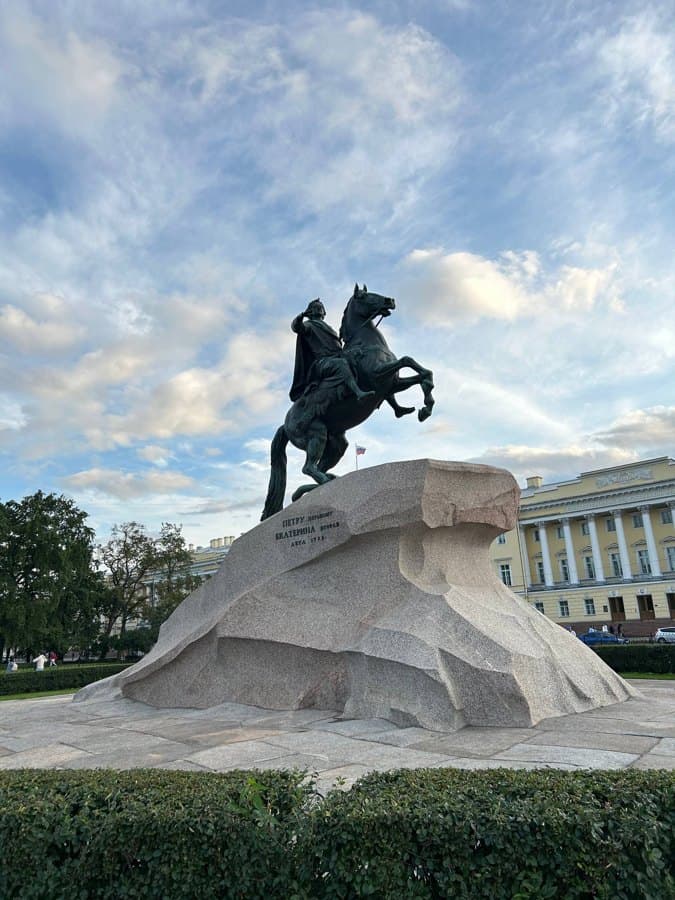
On the other bank stands the monument to Peter the Great, unveiled on 7 August 1782. The Encyclopaedia of St Petersburg calls it the first sculptural monument in the city and in Russia as a whole. Étienne Maurice Falconet worked on the equestrian statue for 12 years; the emperor's face was modelled by his pupil Marie-Anne Collot, and the snake under the hooves was cast from a model by Fyodor Gordeyev. The pedestal is the "Thunder Stone" from near Lakhta, weighing more than a thousand tonnes — special barges and ships were built to move it.

The Bronze Horseman on the Thunder Stone, with the Russian inscription "To Peter the First from Catherine the Second" — Photo: PiterPass
The name "Bronze Horseman" (Medny vsadnik) comes from Pushkin's poem. One side of the pedestal carries the inscription in Russian, the other in Latin — walk around to see both.