From the Vyborg Highway, Shuvalovskoye Cemetery looks like a village churchyard on a hill: two churches, a fence, trees. Walk in and climb to the upper church, and the Suzdal Lake opens below — Ozerki, the dacha shores — and you understand why, since the eighteenth century, those who could choose chose to be buried here. It is a necropolis, a park and a viewpoint at once.
The church on the hilltop above the lake. Photo: Wikimedia Commons
The oldest in the north
The cemetery grew up beside the Shuvalov estate in the eighteenth century as the parish ground for the surrounding villages; according to the Citywalls database, a wooden church already stood here in the 1750s. The present churches are the Saviour Not Made by Hands, 1790s, and Alexander Nevsky, 1880s. Both are in use and stand at different levels of the hill.
Two churches
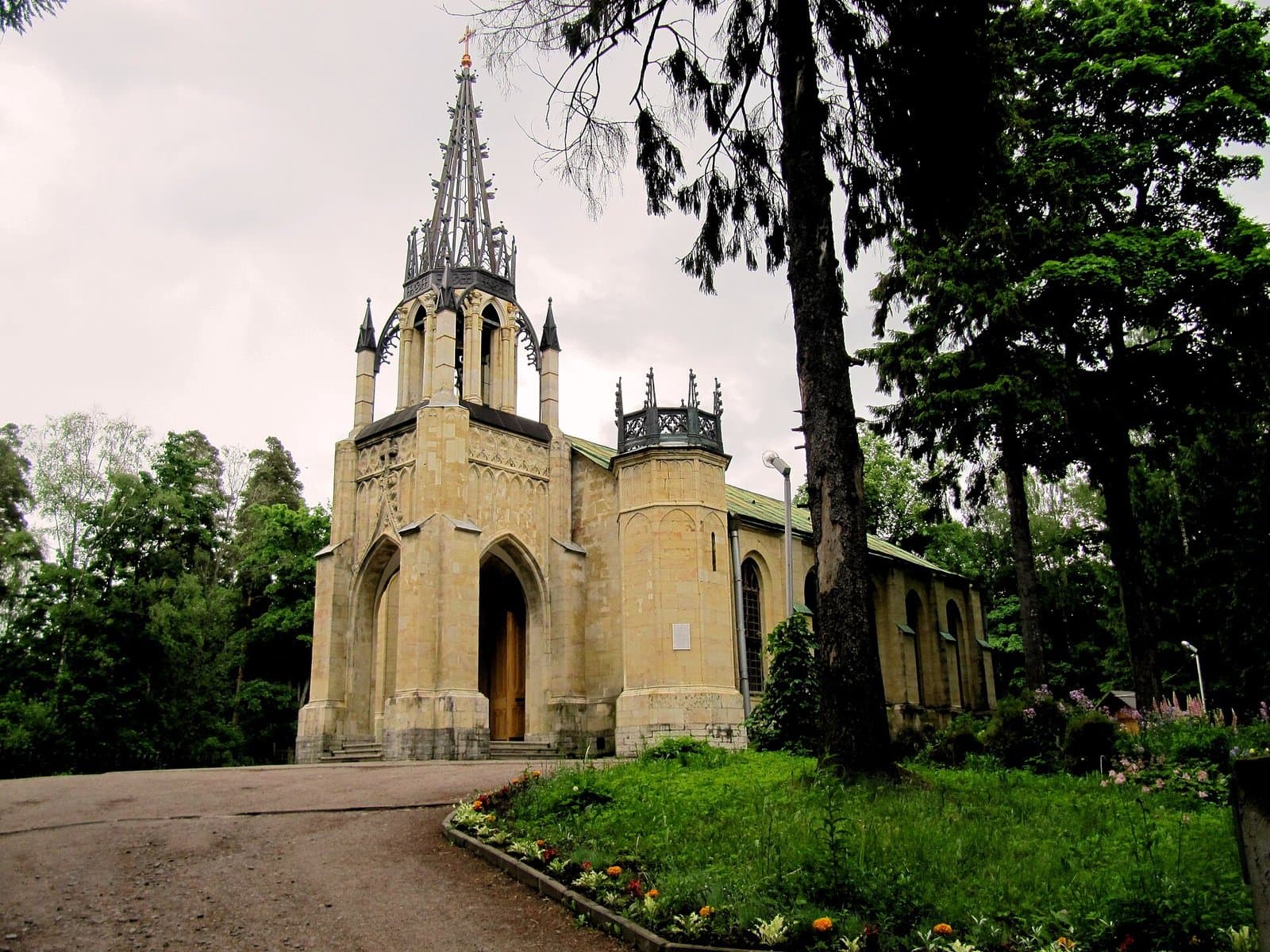
The lower church, the Saviour, is small and classical with a bell tower, by the main gate. The upper, Alexander Nevsky, is in the Russian style with a tented roof on the highest point of the hill. Between them an alley climbs past the old graves.
The upper church of Alexander Nevsky in the Russian style. Photo: Wikimedia Commons
The lake view
From the upper church the view takes in the Lower Suzdal Lake: water, the far shore with its dachas, bathing places in summer, ice in winter. It is one of the few cemeteries people visit for the view. Best in late autumn, when the leaves are down and the whole lake shows, and at sunset in any season.
The Suzdal Lake from the cemetery hill. Photo: Wikimedia Commons
Whom to look for
Buried here are figures of science, theatre and literature of the nineteenth and twentieth centuries: professors of the university and the Academy, actors of the city's theatres, Soviet-era writers. A plan by the main gate marks the notable graves. The old plots with cast-iron railings and nineteenth-century headstones are in the upper part.
Nineteenth-century headstones on the old plots. Photo: Wikimedia Commons
The alley between the lower and upper churches. Photo: Wikimedia Commons