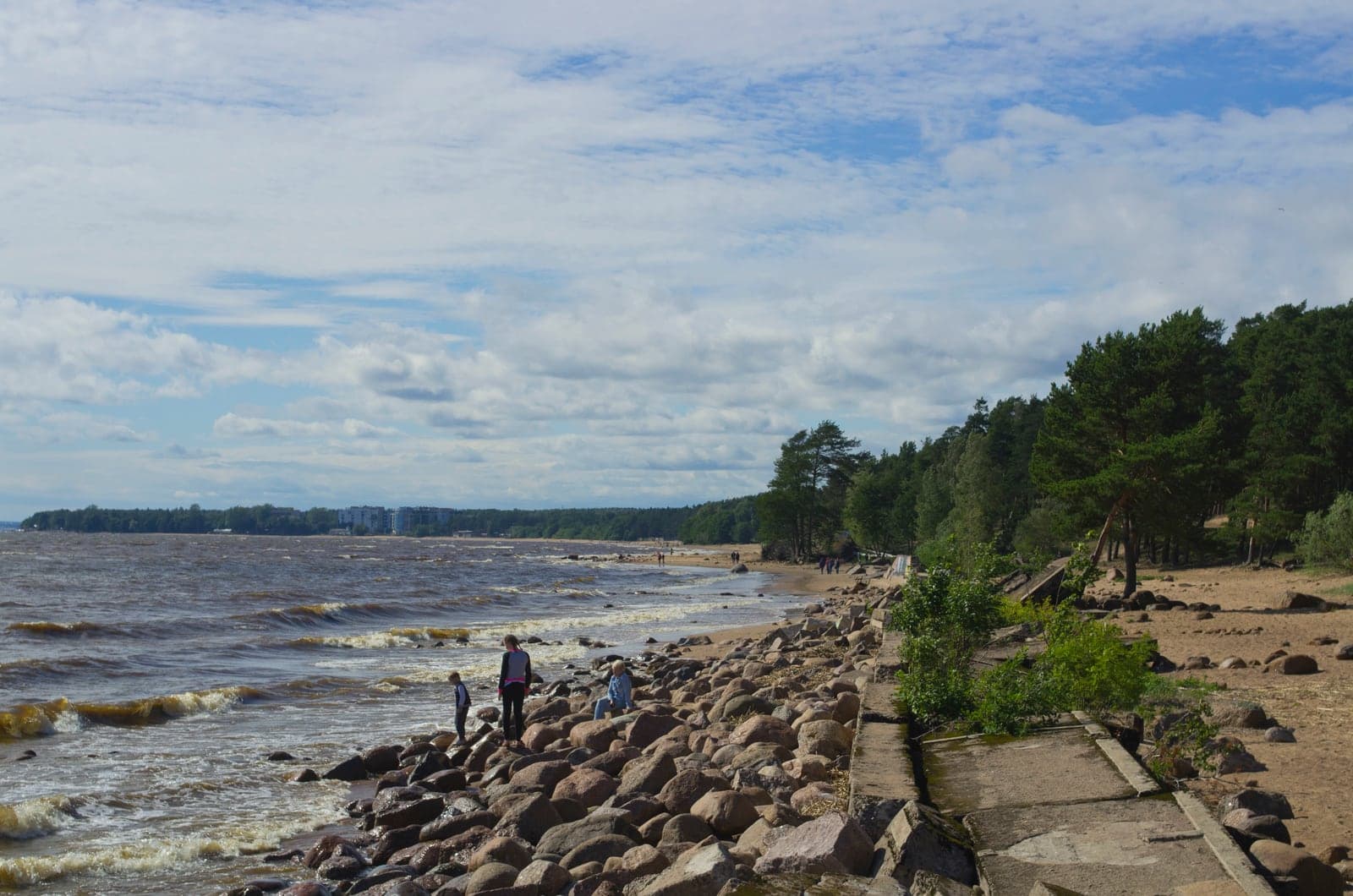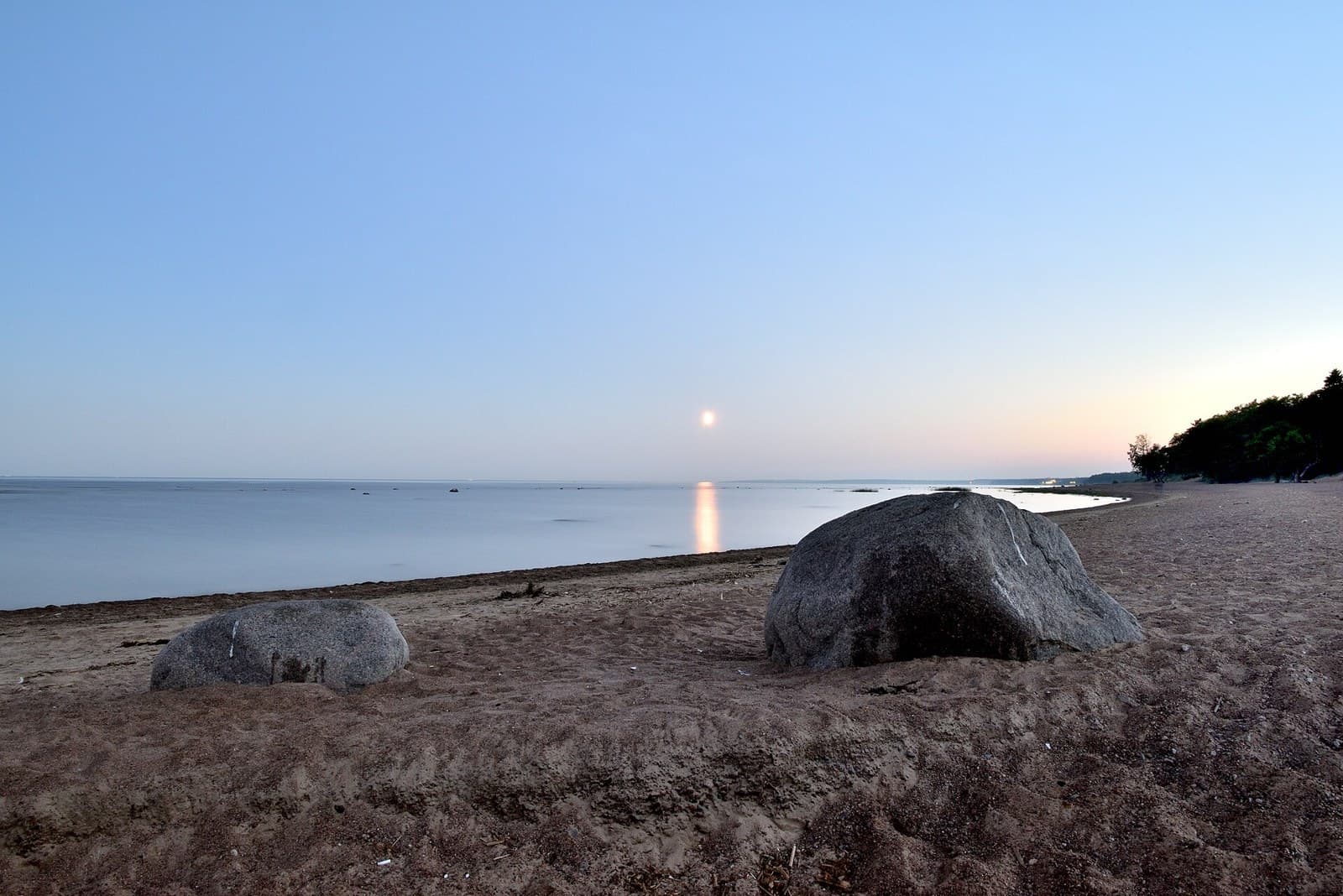
Komarovo fits into half a day if you leave Finlyandsky station in the morning and keep the order: the necropolis first — the farthest point, about two kilometres from the platform along Ozyornaya Street — then Akhmatova's dacha, the «Budka», on Osipenko Street, then the gulf and the 2.8 km «Komarovsky Bereg» eco-trail, then the train home. Evening trains from Komarovo to the city run daily at 16:39 and 17:24 (Lastochka) and 19:43, 20:18, 20:58 and 22:34.
Know this first: there is no Akhmatova house-museum in Komarovo. The dacha belongs to the Literary Fund and tours look at it from the street. The museum part of her story is in the city, at the Fountain House; Komarovo has the grave, the house, a plaque and pines. For another way to spend a day on this coast, see Sestroretsk and Komarovo in autumn.
Getting there
Finlyandsky station is on the right bank of the Neva at metro Ploshchad Lenina (red line). Take any Vyborg-direction suburban train or Lastochka that stops at Komarovo. Check the morning timetable with the operator SZPPK on the day; the evening return trains above are from the station listing for 7 October. At weekends the evening gap can reach ninety minutes, the main reason not to linger on the beach after dark. Which station serves which direction is in our station guide.
The necropolis, two kilometres from the platform
The cemetery dates from December 1913 and became a necropolis in the 1950s, when writers', composers' and theatre retreats opened in Komarovo, Repino and Zelenogorsk. It is on the UNESCO list as a component of the «Historic Centre of Saint Petersburg and Related Groups of Monuments». Buried here: Anna Akhmatova; the philologist Dmitry Likhachev; the writers Vera Panova, Gennady Gor and Yuri Rytkheu; the science-fiction author Ivan Yefremov; the painter Natan Altman; the composer Sergey Kuryokhin; the film directors Iosif Kheifits and Viktor Tregubovich; the actor Andrey Krasko; the neurophysiologist Natalia Bekhtereva; the Nobel physicist Zhores Alferov.
Akhmatova's «Budka»
Akhmatova called the Literary Fund dacha on Osipenko Street her «Budka» (kennel); in the 1950s–60s it was the informal centre of literary life in the village. There is a plaque and no entry. From 1956 she also stayed often at the Writers' House of Creativity in Komarovo, in corner room 12 on the ground floor.
The Strugatskys, the Germans, the academicians
Komarovo has two layers. The academic one began on 14 October 1945, when the Soviet government ordered 25 dachas built west of the station for members of the Academy of Sciences; in 1948 Kellomäki was renamed after the Academy's president Vladimir Komarov. The literary one: Shostakovich, the actor Nikolai Cherkasov, the Strugatsky brothers and Ivan Yefremov stayed here — by Wikipedia's account, the Strugatskys conceived their «Zone» in Komarovo.