St. Petersburg residents ride the metro every day and long ago stopped noticing what makes it unusual. Yet the city's subway is one of the deepest and strangest in the world, with its own engineering lore and details you won't find anywhere else. Here are ten facts that surprise even people who've ridden the blue line for decades.
🚇 Five facts about its history and design
1. The metro opened in 1955. The first line — from Avtovo to Ploshchad Vosstaniya — had just 8 stations. Today there are more than sixty.
2. Until 1982, it was the northernmost metro in the world — until Helsinki's opened. Before that, St. Petersburg's subway held the title outright.
3. The "M" on the logo is blue. That's the only case among all Russian metro systems: in Moscow, Kazan, Novosibirsk and Yekaterinburg, the sign is red.
4. The metro was built so deep because of the soil. The upper layers of ground in the city are unstable and waterlogged — so-called quicksand layers. Builders had to go down dozens of meters to reach solid rock, which is where the system's reputation as one of the deepest in the world comes from.
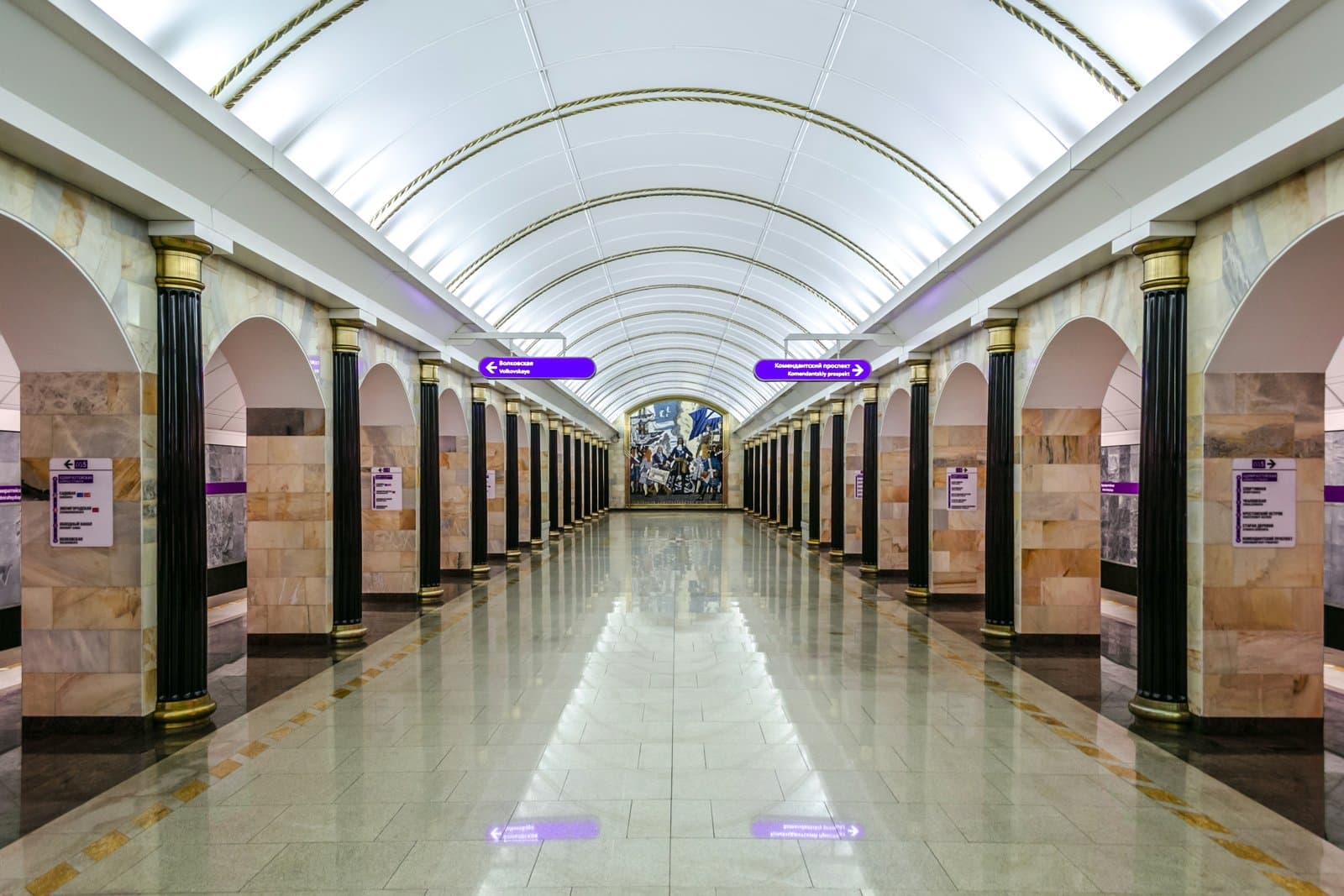
5. Admiralteyskaya is the deepest station in Russia. It only opened in 2011, even though it was planned back in the 1990s — construction was delayed for years over problems resettling a building above the future station. Sources disagree on its exact depth, citing anywhere from 86 to 102 meters depending on the measurement method, but either way it's the deepest platform in the country.
🎭 Five more details that set the St. Petersburg subway apart
6. "Horizontal elevator" stations were invented right here, in Leningrad. At closed-type stations — Park Pobedy, for example — there's no ordinary platform edge: instead there's a solid wall with doors that open in sync with the train doors. By the commonly cited version, Park Pobedy was the first such station in the world; the solution was invented to save money — the tunnels were bored straight through, without pylons or columns, which made construction nearly twice as cheap.
7. The first-stage stations are known as "underground palaces." Marble, mosaics, stained glass, stucco — the 1955 stations were designed as a single ensemble in the spirit of Stalinist Empire style, and many are officially protected as architectural monuments.
8. Devyatkino has its own iconic sculpture — the "bird of happiness." The station isn't just the busiest terminus on the system; it's also home to a recognizable art object that's become a local landmark.
9. The system is more compact than Moscow's, but busier per station. In 2025, the average daily flow per station in St. Petersburg was higher than in Moscow — fewer stations carry more passengers each.
10. In 2025, the metro carried 669.3 million passengers — more than the entire population of Russia passing through the turnstiles about five times over.