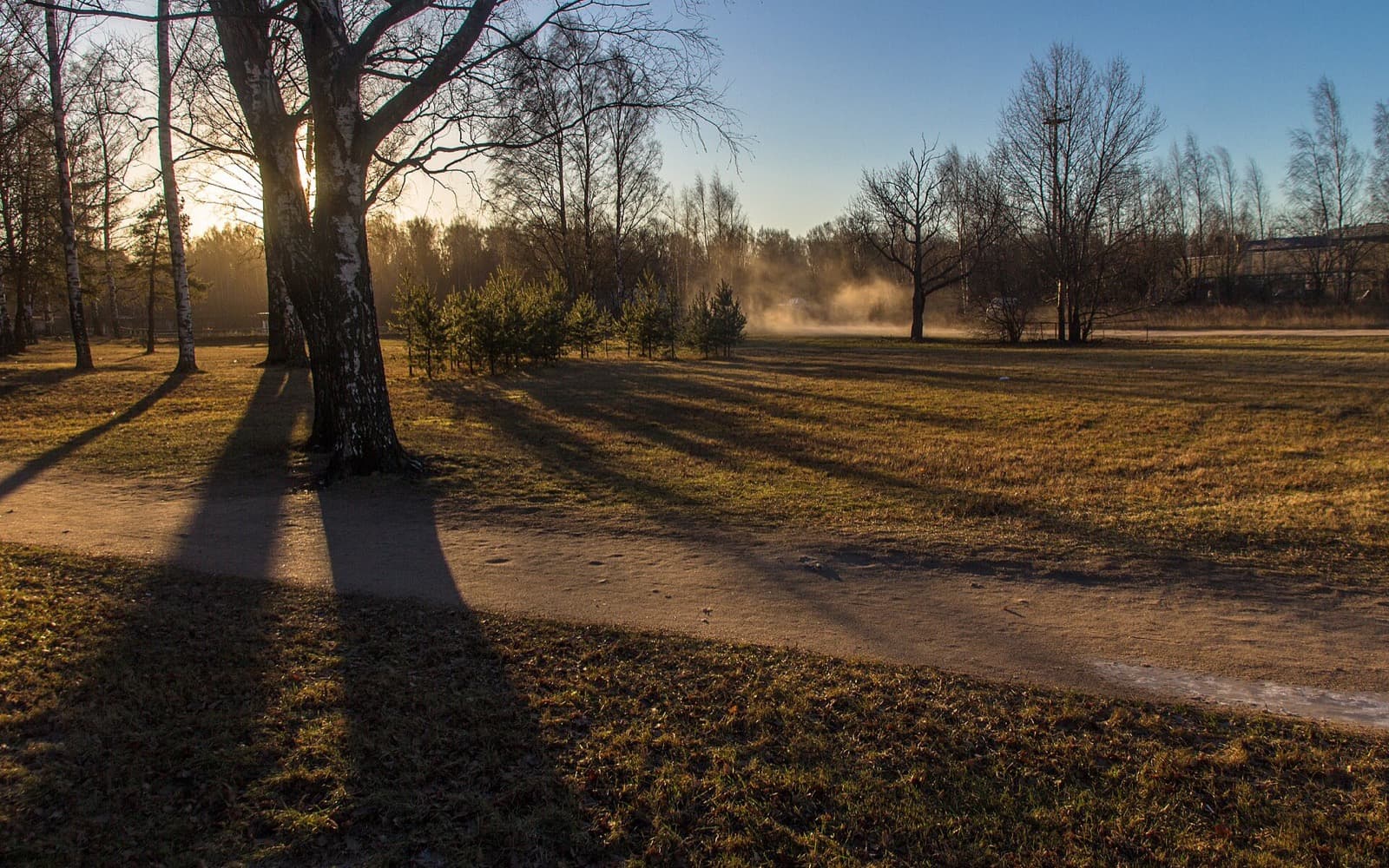
In October the Summer Garden and the parks of Tsarskoye Selo are crowded even on a Tuesday, while half an hour from the centre there are forest parks where you will meet only dog walkers and runners. These are not hidden gems: they are ordinary district parks where Petersburgers go with a thermos on weekends. Seven of them, with addresses, directions and an honest description of what to expect.
Sosnovka: 302 hectares of pine forest inside the city
The largest and the most genuinely forested of them: pine trees, sandy paths, low bilberry shrubs. It is bounded by Severny, Tikhoretsky, Svetlanovsky and Toreza avenues, and the central alley runs along Zhaka Dyuklo Street. It is about 1.7 km from Politekhnicheskaya metro station and 2.1 km from Udelnaya.
Two odd facts. In 1840, roughly where Toreza and Svetlanovsky avenues cross today, the poet Mikhail Lermontov fought a duel with the son of the French ambassador; nobody was hurt, but Lermontov was exiled to the Caucasus. And from 1942 to 1945 a military airfield operated here. Allow two to three hours: the park is far bigger than it looks on a map.
Udelny Park: an ancient sea shore and wartime pillboxes
Seven minutes from Pionerskaya metro station (700 m), 1.2 km from Udelnaya. Since 2013 the park has been a protected heritage site of regional significance — a rare case where the protection covers a landscape rather than a building.
The landscape earns it. The park sits on two terraces divided by a five to six metre escarpment: the shore of an ancient sea, cut by ravines with streams. In autumn the upper terrace gives the best view of the yellow canopy below. Deeper in the park three concrete pillboxes survive from the war, when a rear defence line ran through here.
Forest Technical Academy Park: ponds in shell craters
The campus of the country's oldest forestry university, 900 m from Lesnaya metro station, is both a park and a teaching collection of trees assembled since 1811. Its botanical garden holds the status of a specially protected natural area of federal significance. Several ponds formed in craters left by wartime shelling. The park is open to walk through, but remember it is a working university campus.
Piskaryovsky Park: real forest and birds
116 hectares near Akademicheskaya metro station (1.5 km). No major landscaping was ever done here, so it remains a piece of natural forest with deadwood, undergrowth and a lot of birdlife. One thing to know: the Piskaryovskoye Memorial Cemetery, where victims of the Siege of Leningrad are buried, adjoins the park on the east. They are separate places, but it is worth knowing which one you have walked into.
Murinsky Park, Polyustrovsky Park and the 300th Anniversary Park
Murinsky Park stretches for 115 hectares along a stream in the Kalininsky district, about 1.5 km from Grazhdansky Prospekt or Akademicheskaya. Polyustrovsky Park has three ponds and a history of iron-rich springs that Peter the Great called "steel waters"; it is far from the metro, so take trolleybus 1, 3, 16 or 43, or bus 37 or 106 from Finlyandsky station. The Park of the 300th Anniversary is the only one on the water: five minutes from Begovaya metro station, with a long embankment, sunsets over the gulf and a footbridge to Krestovsky Island. Dress warmer than you think — the wind off the water never stops.
Shuvalovsky Park: a manor, a Parnassus and Napoleon's ponds
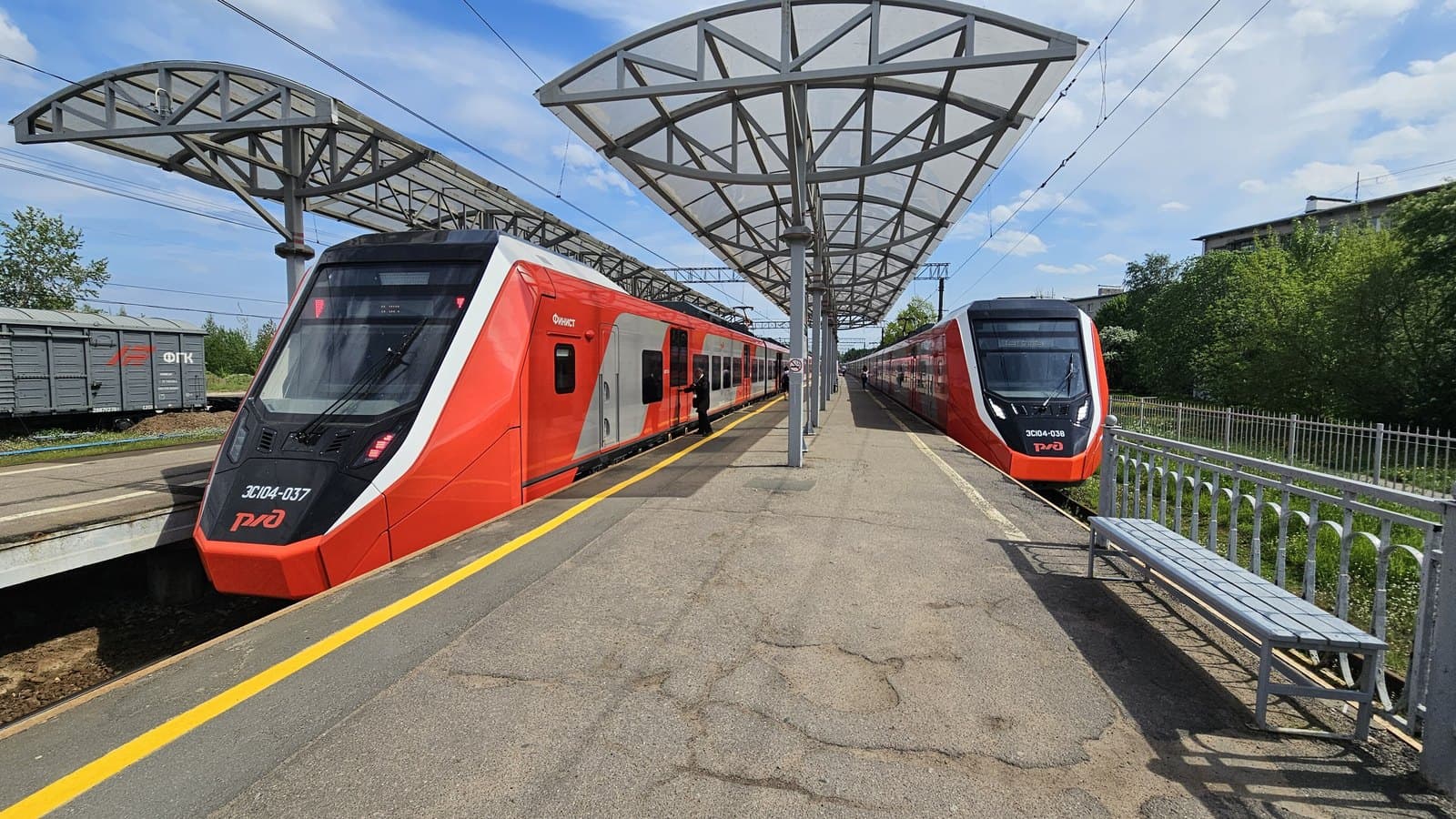
Technically still the city, in practice the countryside: 142 hectares in Pargolovo, 136 of them inside a protected heritage zone where new construction is banned. Take a suburban train from Finlyandsky station to Pargolovo, then walk 800 m. The layout survives from the 1820s: twelve ponds, two nicknamed "Napoleon's Hat" and "Napoleon's Shirt", an artificial hill called Parnassus, a Gothic church and wooden dachas. Many buildings are in poor condition — look from the outside and do not climb in.
Practical notes
All of these parks are free and open at any hour: city forest parks have no fences, no ticket offices and no published opening times. If a temporary restriction appears, the district administration posts it on gov.spb.ru.
And the main thing. These are not attractions but places where people step out of their own front doors — with children, dogs and running shoes. Do not play music out loud, do not leave rubbish, do not photograph people's windows. Behave like a guest in someone's courtyard, and an October evening will give you an empty avenue, yellow canopy and the kind of silence people usually drive to the suburbs for.
Frequently asked questions
Do I need a ticket for Sosnovka, Udelny or Piskaryovsky Park?
No. Saint Petersburg's city forest parks are free and open around the clock; they have no fences or ticket offices.
Which park is best for autumn colour away from the crowds?
Udelny Park for its terraces and ravines, Sosnovka for pine forest, Murinsky Park along the stream, and Shuvalovsky Park in Pargolovo.
How do I get to Shuvalovsky Park?
Suburban train from Finlyandsky station to Pargolovo, then about 800 m on foot. From Prospekt Prosveshcheniya metro station it is nearly four kilometres.
Is the Forest Technical Academy Park open to visitors?
Yes, you can walk through, although it is an active university campus. Access rules for its botanical garden, a federally protected natural area, should be checked with the university.
Which park has a view of the water?
The Park of the 300th Anniversary of Saint Petersburg, on the Gulf of Finland by Begovaya metro station, with a footbridge to Krestovsky Island.
Areas, boundaries and history from Russian Wikipedia entries on each park; heritage statuses from the same source. Distances to metro stations calculated from OpenStreetMap coordinates. City forest parks have no separately published opening hours; temporary restrictions are announced by district administrations on gov.spb.ru. Checked 9 September 2026. Cover photo: Alexey Komarov, CC BY 3.0, Wikimedia Commons.