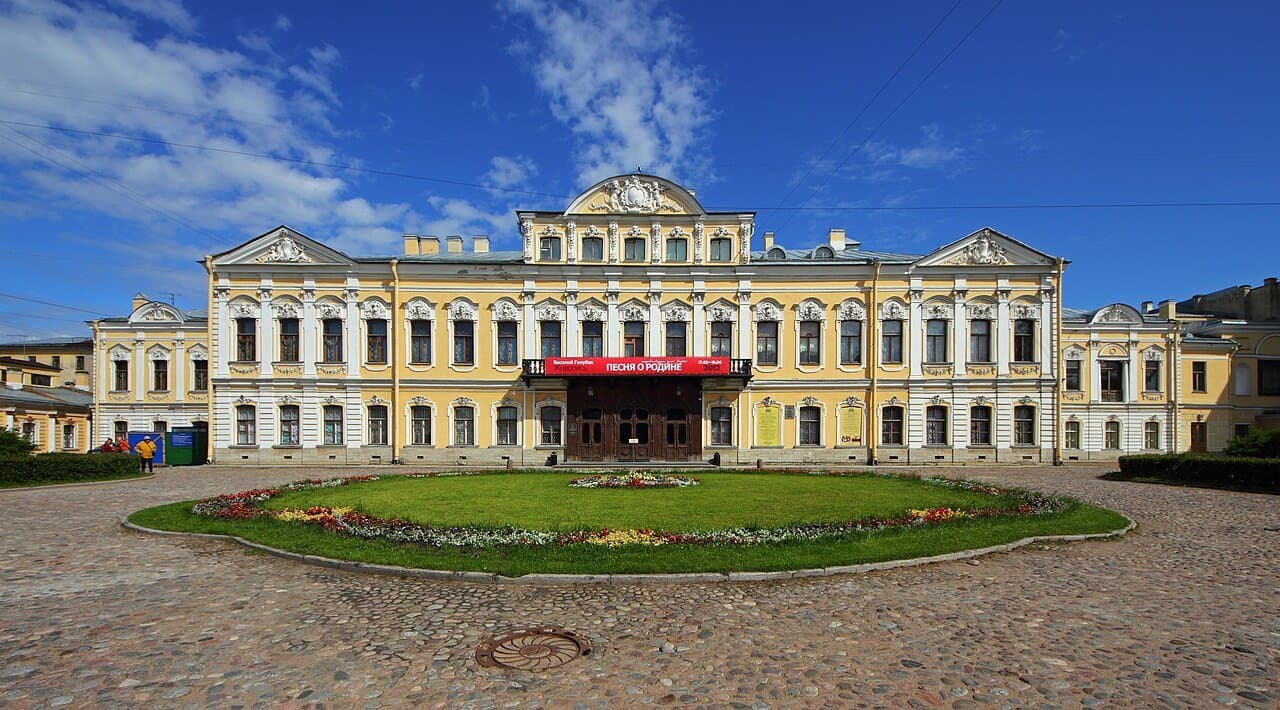
At 34 Fontanka Embankment stands a palace with a history so layered that two entirely different museums now share one roof — and both are worth a dedicated visit. The Fountain House remembers a serf actress who became a countess, and a poet who lived here for decades in a Soviet communal apartment built inside the former state rooms.
🎻 The Museum of Music in the main building
The Fountain House was built between the 1730s and 1850s — architects Chevakinsky, Voronikhin, Quarenghi and Starov all worked on different parts of it. Today the main building houses the Museum of Music, part of the St. Petersburg State Museum of Theatre and Music Art. Its halls hold violins made by Stradivari and Amati, and pianos that once belonged to Anton Rubinstein and Mikhail Glinka. The Sheremetev family was known across St. Petersburg for its musical life — this is where the palace's famous serf choir once performed.
💔 Praskovya Zhemchugova: a story that became legend
One of the palace's best-known stories involves Praskovya Kovalyova-Zhemchugova, a serf actress who became the wife of Count Nikolai Sheremetev. She lived in this house, gave birth to a son here — and died twenty days after the birth. It remains one of the most poignant stories in the history of St. Petersburg's aristocracy.
📖 The Anna Akhmatova Museum in the south wing
A separate wing of the palace, the south wing, houses the Anna Akhmatova Museum — the poet moved in here in 1926 with her husband Nikolai Punin and his family, and lived within these walls for many years, with a break for evacuation during the war. The museum opened in 1989, marking the centenary of her birth, and recreates the cramped communal-apartment life that filled the former palace rooms during the Soviet era.
📌 In short
✅ The Fountain House at 34 Fontanka Embankment is the former palace of the Sheremetev counts, built between the 1730s and 1850s.
✅ The main building holds the Museum of Music, with violins by Stradivari and Amati and pianos owned by Glinka and Rubinstein.
✅ The south wing houses the Anna Akhmatova Museum — the poet lived here for many years, until 1952.
✅ These are technically two separate museums sharing one site — check in advance which one (or both) you want to visit.
✅ Check current hours and tickets on the museums' official websites, as sources differ on some exact dates.
If you're planning a visit, budget time for both museums — they have very different moods: one celebrates the grandeur of palace musical life, the other the cramped quiet of a Soviet communal apartment where poetry was written.