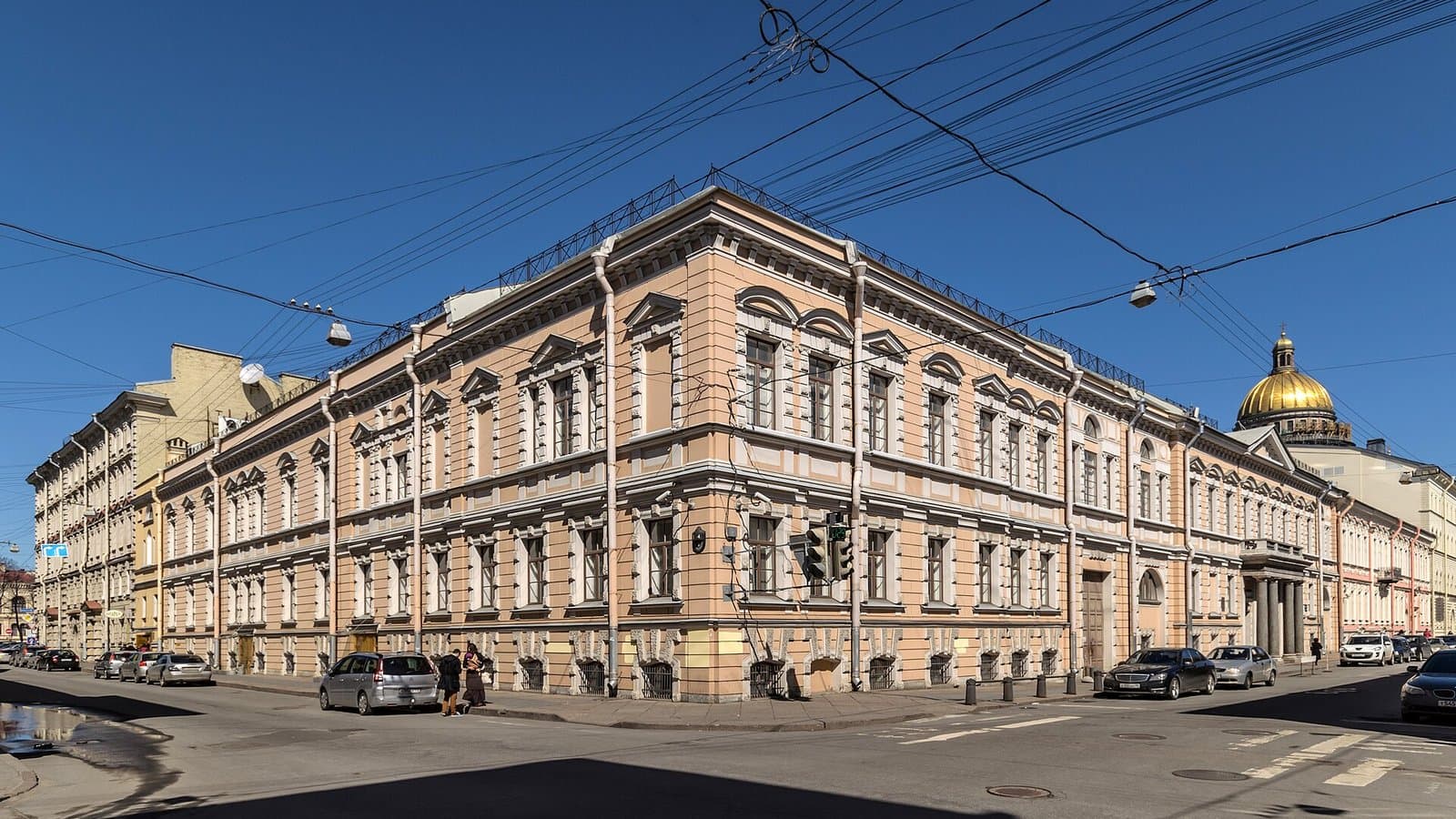
Pochtamtskaya Street (Post Office Street), a couple of minutes from St Isaac's Square, is one of the quietest in the centre, and most tourists walk past the pale palace on the corner of Pochtamtsky Lane without looking up. Yet this is the former palace of Chancellor Bezborodko, designed by Quarenghi, and inside is the A. S. Popov Central Museum of Communications: from 19th-century mail carts to satellite communications and one of the world's largest stamp collections. In late October, when it is dark by 17:25 and the embankments are windy, it is a calm two-hour museum right in the centre.
On 19 October 2026 we checked the museum's official websites (old and new) for opening and ticket-desk hours, entry and family ticket prices, the free day, how to book tours, current exhibitions and the history of the palace. Distance to the metro is from Yandex Maps.
🏛 Bezborodko's Bronze Palace
The palace was built for Alexander Bezborodko, a close associate of Catherine the Great, who took charge of the postal service in 1782 and became chancellor under Paul I. In 1783 Giacomo Quarenghi joined two older houses with a central wing and added a storey. Bezborodko filled it with more than three hundred paintings, sculpture, porcelain and a collection of black bronzes, which gave the building its nickname, the Bronze Palace.

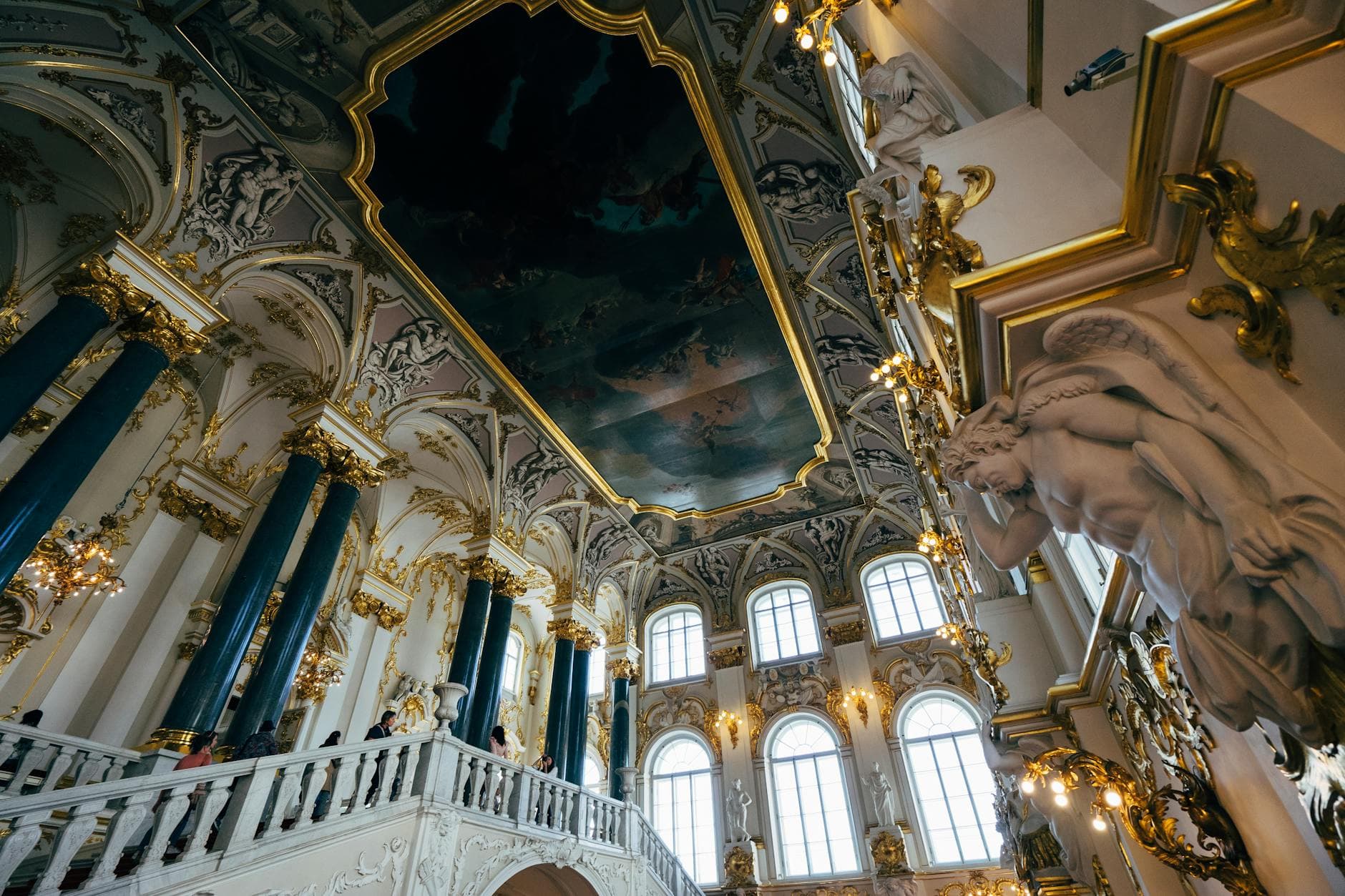
The painted ceiling of the Oval Hall in the Bezborodko Palace — Photo: Ekaterina Borisova, Wikimedia Commons, CC BY-SA 4.0
From 1829 the palace belonged to the postal service for almost a hundred years: Quarenghi's Grand State Hall became the Post Office Church, used for worship until 1922, and from 1884 to 1917 the Main Directorate of Posts and Telegraphs of the Empire was based here. The museum was moved here by a decision of 1924. In 1974 the displays were closed because the building was unsafe, and by 2001 the state heritage committee (KGIOP) assessed its wear at 60 %. During the 2001–2003 reconstruction, fragments of historic wall painting in the state rooms were conserved and the stucco restored.
📡 The atriums: a satellite under a glass roof
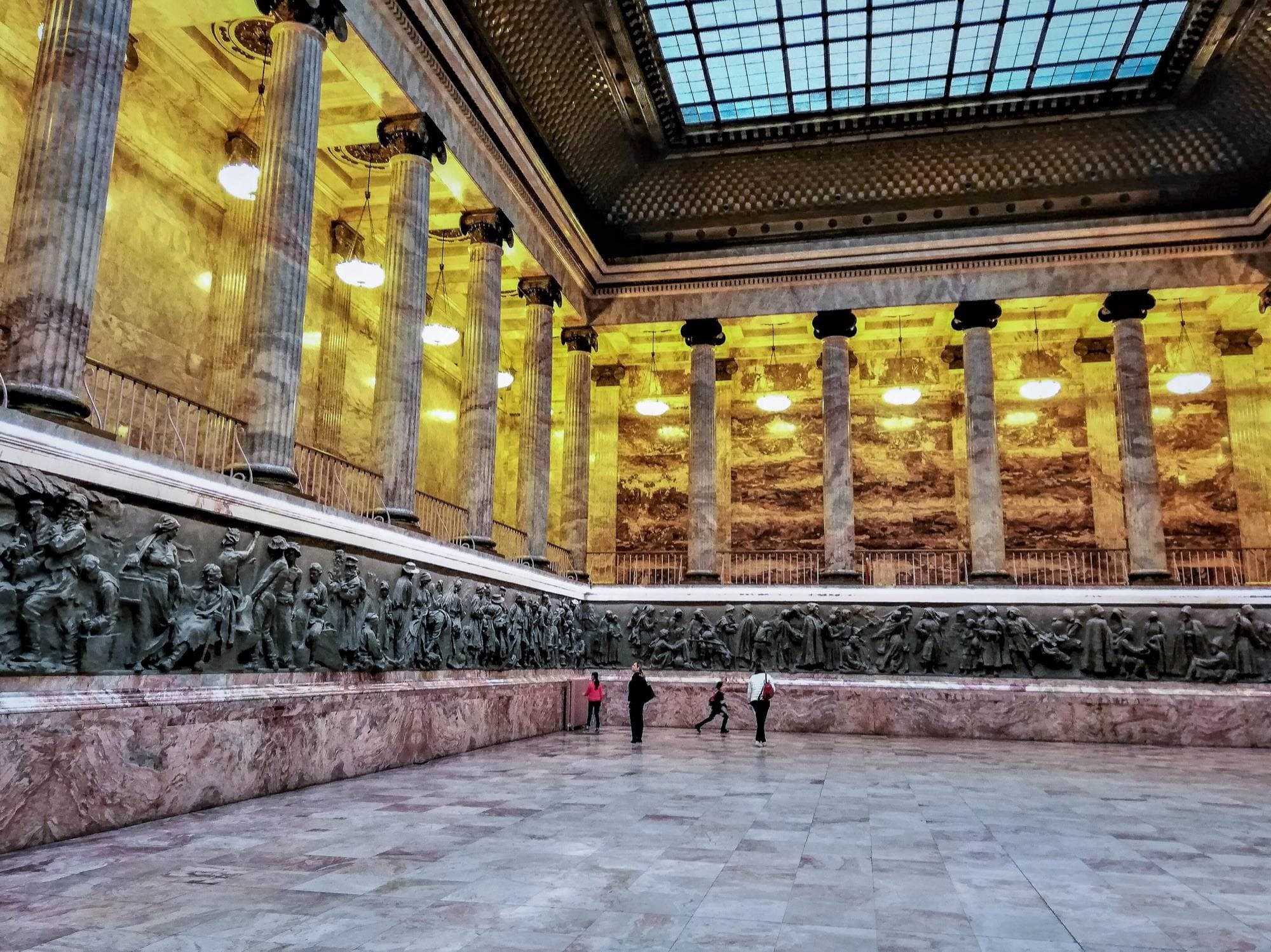
During the reconstruction the inner courtyards were turned into two atriums, bright halls under glass roofs. They hold large exhibits and temporary shows, and this is where the museum looks most unexpected: old wing façades, with antennas and satellite equipment in the middle.

The museum atrium with a satellite dish under the glass roof — Photo: Frank Pitsch, Wikimedia Commons, CC BY-SA 3.0
On now: until 15 November 2026, "For the Good of Russia", marking 225 years since the birth of Boris Jacobi, whose discoveries, the museum says, laid the foundation for telegraphy and electrical engineering; and until 31 December, "Iconic Mobile Phones", from 1991 handsets to the present day.
✉️ The post: carts, boxes and stamps
The collections have been assembled since 1872, starting from the Postal Department of the Polytechnic Exhibition. The postal display is the most tangible part: a mail cart from the first half of the 19th century and a whole wall of post boxes from different eras, marked "For letters" and "For parcels".

Post boxes from different years in the museum display — Photo: Ekaterina Borisova, Wikimedia Commons, CC BY-SA 4.0
The great treasure for philatelists is the State Collection of Postage Stamps, kept since 1884. The museum calls it the largest systematic collection of stamps from every country in the world; it receives new issues via the Universal Postal Union bureau in Bern. Its most valuable part — about 1,300 stamps, letters, cards and design sketches from 1743 to 1923 — is kept in the "Treasury of Russian Postage Stamps". It can only be visited on a guided tour, and all tours at the museum must be booked in advance by phone.
☎️ Telegraph, telephone, radio, space
The equipment collections trace the path from the first telegraph and telephone sets to radio, television, satellite equipment, mobile phones and computers. The most striking object in this section is the wooden Geisler manual telephone switchboard, as wide as a wall.

The Geisler manual telephone switchboard — Photo: Knizhnaya pyl, Wikimedia Commons, CC BY 4.0
🎟 Tickets, timing and combining with St Isaac's
Entry to the permanent displays, including current exhibitions, is 450 roubles for adults, 350 for schoolchildren, students and pensioners and 200 for pre-schoolers aged 4–7. A separate ticket for the temporary exhibition in the atriums only costs 150 and 100 roubles. At weekends there is a family ticket for one adult and two children at 650 roubles; the audio guide is 500 roubles. Paying with the Pushkin Card is temporarily unavailable, the museum says. No separate foreigners' price is listed; foreign bank cards do not work in Russia, so bring cash or a Russian card. Tours are in Russian.
Allow about two hours, more with the Treasury. The museum closes at 18:00, so on a short autumn day a good order is St Isaac's Cathedral first, while it is light, then along Pochtamtskaya Street past the Main Post Office building to the museum. The visitor entrance is from Pochtamtsky Lane. According to Yandex Maps, Admiralteyskaya metro is about a kilometre away; the museum also names Nevsky Prospekt metro, buses 3, 22 and 27 and trolleybuses 5 and 22.
🧭 Good to know
- Closed on Mondays; Tuesday–Sunday 10:30–18:00, ticket desk until 17:30.
- The last Wednesday of the month is a social day: free for visitors under 18, school pupils and students (28 October, 25 November). Other free dates are in our guide to free museum days.
- Guided tours and the Treasury are by advance phone booking only.
- The museum has two websites, old and new; the hours match, and ticket prices are on the "Tickets" page of the old site.
- A good rainy-day option; more ideas in where to go in the rain.
- With children: the weekend family ticket and the "Museum for Children" section of the website.
- Not for you if you expect an interactive science centre — this is mostly display cases and original equipment — or if technology and the post leave you completely cold.
📌 In short
✅ The Popov Central Museum of Communications is at 7 Pochtamtskaya Street, entrance from Pochtamtsky Lane, next to St Isaac's Square.
✅ Tue–Sun 10:30–18:00, ticket desk until 17:30, closed Monday.
✅ Tickets 450 roubles, concessions 350, pre-schoolers 200, audio guide 500.
✅ Highlights: the atrium with satellite equipment, the postal display, the switchboards and the stamp Treasury (tour only).
✅ Allow about two hours and combine it with St Isaac's.
The Museum of Communications is a rare place where the building and the collection tell the same story: the palace of the head of the postal service served as the postal ministry for almost a century and now keeps its objects. Checked on 19 October 2026 against the official websites of the A. S. Popov Central Museum of Communications (tickets, opening hours, contacts, palace history, collections, the Treasury and exhibitions) and Yandex Maps.
Cover photo: Florstein (WikiPhoto.Space), Викисклад, CC BY-SA 4.0 (https://commons.wikimedia.org/wiki/File:Central_Telecommunications_Museum.jpg)