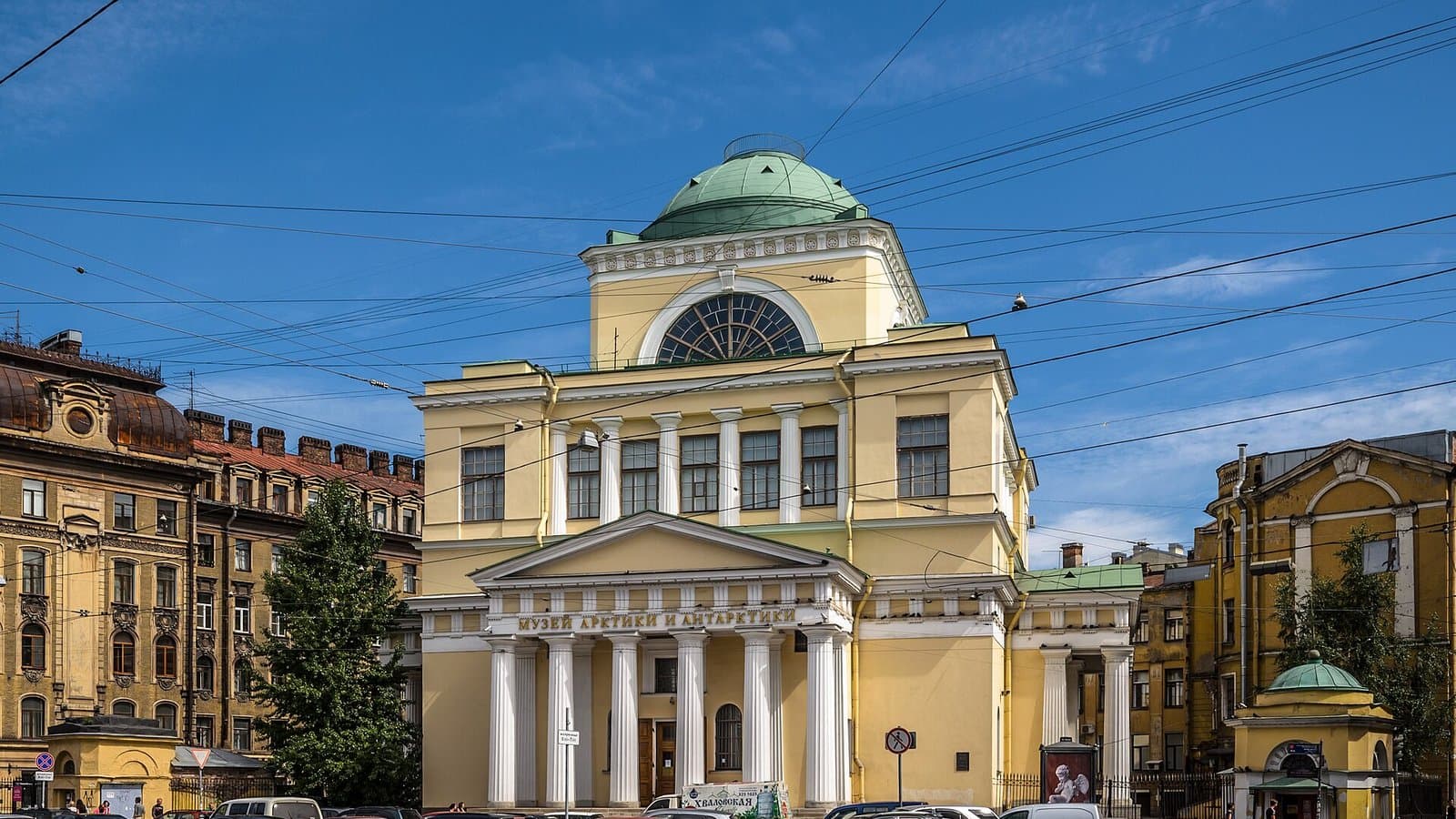
The yellow building with a colonnade and a green dome on Marata Street is easy to mistake for an ordinary St Petersburg church — and that is exactly what it was. Since the 1930s it has housed the Russian State Museum of the Arctic and Antarctic, and a seaplane now hangs under the former church's dome. The first thing we checked: the museum is open, at the same address, 24a Marata Street (ulitsa Marata). In late October it is a handy stop: a compact building, an hour and a half to two hours indoors, and a subject that suits the cold weather outside surprisingly well.
On 19 October 2026 we checked the museum's official website for opening hours and the sanitary day, prices for entry, the audio guide and tours, free days, the permanent displays and current exhibitions. Distance to the metro is from Yandex Maps.
⛪ The building: a church turned polar museum
The building went up in 1820–1838 as the St Nicholas Edinoverie Church (a parish of Old Believers in communion with the Orthodox Church). According to the museum, in 1933 it was leased to the new Arctic museum of the All-Union Arctic Institute and rebuilt to a design by the architect Sivkov. The museum opened on 8 January 1937 and took its current name in 1958, after the first Soviet Antarctic expeditions. Today the collection numbers about 100,000 items, and the museum calls itself the world's largest devoted entirely to the polar regions.

The main hall under the former church dome: the Arctic relief model and the seaplane — Photo: Zhuravlik, Wikimedia Commons, CC BY-SA 3.0
Inside, the main impression is the tall domed hall with columns. In the centre is the "Arctic" model: a segment of a globe with a relief map of the northern hemisphere down to the 60th parallel, made in 1936 from Academician Shokalsky's data. Above it hangs the museum's first exhibit, a real Sh-2 amphibious plane designed by Shavrov, built in Leningrad in 1931 and used for ice reconnaissance until the 1960s.
🐻❄️ Arctic nature: dioramas from the 1930s
The first section is about Arctic nature. The real treasure here is not the stuffed animals but the dioramas themselves, made in 1935–1936: "Bird Colony", "Walrus Rookery", "Tundra in Winter", "Tundra in Summer", the Shokalsky Glacier on Novaya Zemlya and the Matochkin Shar strait. It is a rare case of museum scenery becoming a historic exhibit in its own right.
A temporary exhibition about the walrus, "Arctic Giant", based on photographs by Nikolai Gernet and organised with the Russian Arctic National Park, has been extended until 30 December 2026.

A model of a northern polar station in the display — Photo: Zhuravlik, Wikimedia Commons, CC BY-SA 3.0
🚢 The Northern Sea Route: from a wooden koch to nuclear icebreakers
This is the richest section. It opens with a piece of hull planking and the stem of an ancient koch (a Pomor wooden sailing boat) and reconstructed clothing of 16th–17th-century polar seafarers, followed by the "Mangazeya" diorama about a medieval trading town in Russia's far north-east. Pride of place goes to the wheel and binnacle of Yermak, the world's first Arctic icebreaker, built in 1899 to plans by Admiral Makarov.

A ship's wheel and a display on the history of the icebreaker fleet — Photo: Zhuravlik, Wikimedia Commons, CC BY-SA 3.0
Next come the Chelyuskin saga of 1933–1934, the tent of Papanin's North Pole-1, the first drifting ice station, Chkalov's flight over the Pole to America, the collapsible hut of the North Pole-3 station and models of the nuclear icebreakers Lenin and Arktika. The section ends with a working model of the Northern Lights.